Ministry: Teens are ultimately responsible for their own behavior
Disruptive behavior by teenagers is primarily the responsibility of the young people themselves, though schools and local governments also have a role to play in addressing such issues, a senior Education Ministry official said following concerns about unruly students at a school in Põltsamaa.
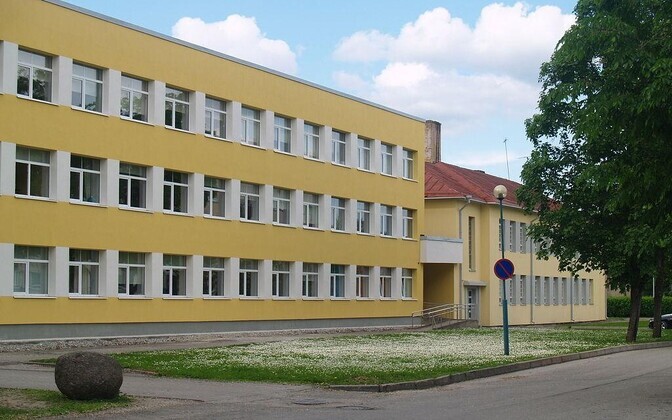
Põltsamaa Basic School recently hired a private security company and issued panic buttons to staff after struggling to manage the behavior of several middle school students.
Speaking on ERR television morning program, school psychologist Karmen Maikalu said similar situations are not unique to Põltsamaa.
"We are hearing about this from across Estonia. In recent days, I have received many calls from school principals and parents around the country saying, 'We have the same problems and it's good that you tried something in addition to the usual measures,'" Maikalu said.

Earlier this week, Põltsamaa Basic School Principal Henry Kallaste told ERR that the problems stem from two or three sixth- and seventh-grade students who do not want to attend school and come mainly to cause trouble.
"They disrupt lessons, prevent teachers from teaching, and kick over trash cans," Kallaste said. "Other children are afraid, and teachers are concerned about how to conduct classes. We had to contact a security company to help limit these boys' activities."
Jürgen Rakaselg, head of the Education Ministry's Inclusive Education Department, told ERR that responsibility is clear under the law.
"First and foremost, every person is responsible for their own behavior," he said.
"There are certain age-related differences, of course, but a young age, a possible mental health condition, or a developmental difference does not justify inappropriate behavior. In some cases, however, it may help explain it."
Young people need love and boundaries
According to Rakaselg, schools are obligated to ensure the physical and psychological safety of all students and provide a safe workplace for employees. Parents are responsible for their children's behavior and any damage they cause, as the root causes of disruptive behavior are often linked to parenting skills and family circumstances.
"Because the school receives the resources needed to address behavioral issues from the school owner, responsibility also falls on the local government. At the same time, that responsibility does not absolve the student of personal responsibility for inappropriate behavior," he said.
Under the new arrangement in Põltsamaa, security personnel can escort disruptive students home so they do not interfere with classes. The school can also suspend students from classes for up to 10 days, the maximum permitted during a school year.
"That is the only option available to the school," Kallaste said, adding that the parents of one disruptive student had admitted they were unable to manage their son.
Maikalu said it is important to understand why children behave this way, not only in Põltsamaa but elsewhere as well.
"Why do they refuse to follow rules and engage in behavior they should not? I have thought about this a lot, and my colleagues say the same thing: young people need two things, love and boundaries. In these cases, they are very often missing both," she said.
Many of the problems originate at home. Parents often tell schools they cannot cope and ask educators to intervene. At the same time, some young people fail to understand that actions have consequences.
She said support for troubled families should begin as early as preschool, because by age 13 it is often already very late to intervene effectively.
"People sometimes ask why the psychologist isn't fixing the child. A psychologist's office is not an auto repair shop where you bring in a broken car and get a repaired one back," Maikalu said.
"You cannot simply take a child and fix them. The entire system around the child needs support and change, including the parents."
Problems with teenage behavior are not new
Rakaselg said the ministry cannot determine whether such incidents have become more common in recent years because it does not monitor daily life in general education schools in enough detail to assess behavioral trends.
"Claims that teenagers' uncontrollable behavior is worse than ever have appeared throughout history and have been documented consistently for roughly the past 200 years," he said.
He added that some of the behavior is typical for the age group and should not surprise those familiar with developmental psychology.
Kallaste said some students who caused serious problems in previous years eventually got back on track.
"They grow out of that stage. It is an age when boys want to prove how tough they are," he said.
The Education Ministry considers temporary suspension from classes to be an appropriate measure in certain situations but cautions that it should not be expected to produce significant or lasting behavioral change.
"Measures that address the underlying causes of behavior are generally more effective for this age group. Suspension is primarily focused on consequences," Rakaselg said.
Closed institutions are an extreme measure
Rakaselg said media coverage of the Põltsamaa case indicates efforts are also being made to address the root causes of the students' behavior, although that process takes time.
If a student's behavior poses a persistent danger to their own health or the safety of others, authorities may need to consider involving law enforcement or placing the child in a secure residential institution.
"These solutions are considered only when the danger is clear and the behavior can no longer be viewed merely as inappropriate or defiant," he said.
Rakaselg added that the Social Insurance Board can support child protection workers if local governments struggle to address the underlying causes.
"The use of security services on this scale clearly suggests the local concern is very serious and that there is a feeling no other options remain. However, security services do not address the causes of behavior and can only maintain order for a limited period. While the school's concerns are clearly serious, relying on security services is not a good long-term solution," he said.
Maikalu stressed that the security company brought in at Põltsamaa is only an additional measure to help enforce boundaries and does not replace other interventions.
She added that helping troubled children requires cooperation among schools, families, police, child protection services, and the broader community.
"It should be a system that works together. Right now, everyone is often doing something separately," Maikalu said, noting that specialists are frequently overburdened and child protection workers often lack the capacity to respond quickly enough.
--
Editor: Karin Koppel, Argo Ideon


