World's oldest Brandt's bat lives in Estonian cave

Scientists have discovered the world's oldest known Brandt's bat in the Piusa caves. The find is also the second-oldest bat ever recorded in Europe, across all species.
Oliver Kalda, a junior research fellow in biodiversity and ecological sustainability at the University of Tartu, said the discovery was largely accidental. Large numbers of bats were banded in the Piusa caves in the late 1980s and early 1990s as scientists studied their fidelity to particular sites, survival rates and age. "When bats return to the same hibernation site and you go back to count them, you can gather information about their age," Kalda said. Scientists are now reaping the benefits of the banding carried out in the early 1990s.
Last February, Kalda and his colleagues visited the caves to conduct a winter bat survey commissioned by the Estonian Environment Agency. The survey aims to track changes in bat populations at different hibernation sites. Scientists monitor the Piusa caves every three years.
"When we find a banded bat that we can reach — because it isn't always practical to try to retrieve one from somewhere high up — we check the band to determine how old it is, whether it was banded there at Piusa and so on," Kalda said.
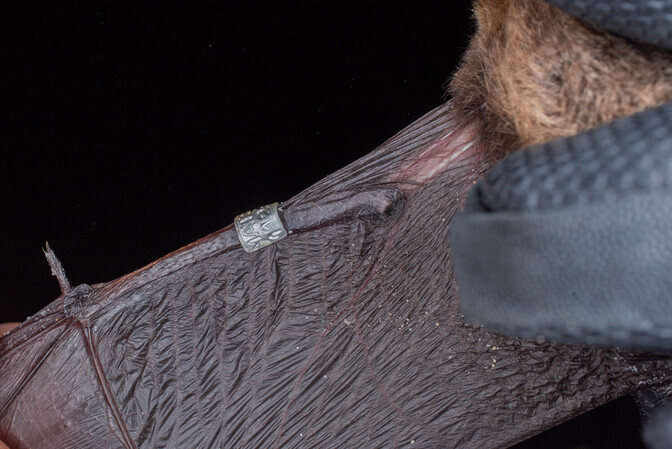
Bird and bat bands are generally very simple, bearing only a band number. The number can be used to look up information in a database, including when and where the animal was banded, its species and age. The records also include the bat's weight and measurements.
The first bat was banded in Estonia on November 9, 1947. It was a brown long-eared bat (Plecotus auritus) hibernating in the Laagri tunnels just outside Tallinn. Between 1947 and 1996, more than 16,000 bats were banded in Estonia. Around 2,000 bats have been banded in the country over the past decade, while in the last few years, only a few dozen have been banded annually.
"In recent years, banding has mainly been associated with bat health research we are conducting at the University of Tartu. We have marked the animals so we know which bats we have already sampled and, with a bit of luck, can measure health indicators in the same animal over different years," Kalda said.
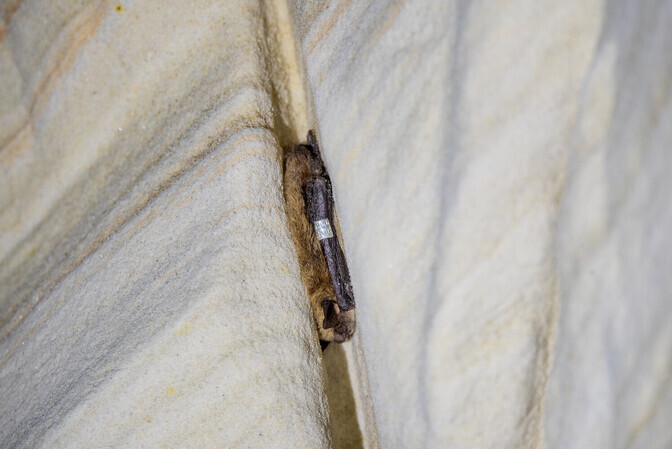
The scientists came across the oldest known Brandt's bat by chance while conducting their count. In this case, the band was immediately visible in the beam of a flashlight.
"Sometimes the wing with the band is positioned toward a crevice where you can't see it or the bat is deep inside a hole. But this one was alone, rather than among other bats and the band immediately caught our attention," Kalda said.
The bat is at least 36 years and seven months old. Kalda explained that determining the exact age of bats can be somewhat difficult. During summer and early fall, their age can be estimated by examining the ossification of their joints. If a bat was born that year, growth plates are visible at the ends of its bones.
The record-breaking bat was banded at Piusa during winter, when it is no longer possible to distinguish whether an animal was born that year or in an earlier summer.
"We can therefore say that this bat is at least 36 years and seven months old," Kalda said.
That makes it the oldest Brandt's bat ever recorded worldwide. The previous record holder was 32 years old.
According to Kalda, it is not known exactly how long Brandt's bats typically live.
"Although bats can live exceptionally long lives, studies have generally estimated their life expectancy at around five to 10 years. However, if everything goes well, they can live considerably longer," he said.
Kalda said the discovery can be viewed as a record-breaking story: the world's oldest Brandt's bat found right here in Estonia's Piusa caves. But it also expands scientific knowledge.
Bat longevity is of particular interest to scientists because these animals are important model species in aging research. Bats live exceptionally long lives relative to their small body mass. Brandt's bats, for example, weigh just seven to nine grams, while rodents of a similar size often live only a couple of years.
"Knowing that bats can live this long allows other scientists to study and compare aspects such as their genetics and physiology to understand why bats are capable of living so much longer than other small mammals. There must be some mechanism behind it," Kalda explained.
The longevity of bats also makes the long-term protection of their habitats particularly important. According to Kalda, the same individual bats have repeatedly been found returning to hibernate in the Piusa caves over several decades. The record-breaking Brandt's bat itself has been observed at Piusa on at least four occasions.
Kalda explained that bats are often creatures of habit, remaining highly faithful to familiar sites. After migrating, they frequently return to the same colony sites where they were born and hibernate in familiar locations.
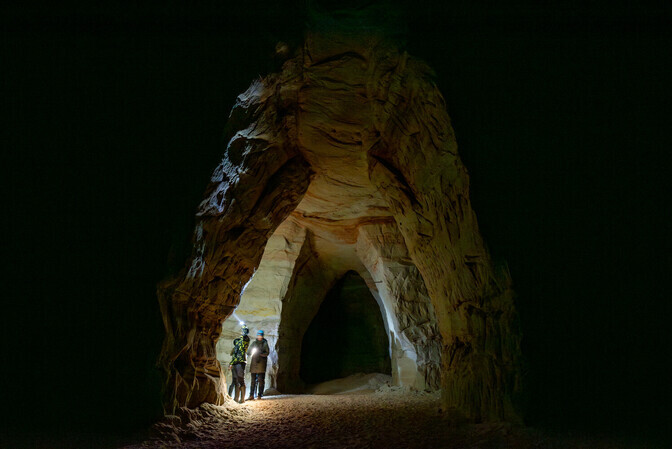
The Piusa cave system is a unique and exceptionally important hibernation site for bats, ranking among the largest in Northern Europe in terms of the number of bats it supports. Kalda said more than 4,200 bats hibernated there last winter.
With winter approaching, Kalda reminded people that access restrictions apply at bat hibernation sites. In Estonia, people are prohibited from entering many large underground sites, including the tunnels of Peter the Great's Naval Fortress near Tallinn, from September 1 through May 1. The restrictions are intended to prevent disturbance to hibernating bats.
"If bats are disturbed and awakened during winter, their energy reserves are depleted more quickly because waking up consumes most of the energy they use during the winter," Kalda explained.
He therefore recommends avoiding excursions and hikes during winter in areas where access restrictions are in place to protect bats.
Bats are among the longest-lived small mammals. In Estonia, Brandt's bats (Myotis brandtii) prefer forest habitats, although they primarily choose buildings surrounded by forests as places to give birth and raise their young. Suitable habitats also include a body of water. The species is largely sedentary, spending both summer and winter in Estonia.
Larger artificial caves, including underground military installations and mine tunnels, provide suitable hibernation sites.
As recently as the 1970s and 1980s, Brandt's bats were rare at hibernation sites, but their numbers in caves have since increased significantly. At some hibernation sites, Brandt's bats are now the most abundant species.
The scientific paper was published in the journal Mammalia.
--
Editor: Marcus Turovski


