Authorities alarmed as Estonian teens climb restricted buildings

Young people are competing for attention by slipping into abandoned buildings and infrastructure sites, prompting concerns that the urban‑exploring craze may pose real security risks.
In recent years, social‑media content has sharply increased in which youngsters outdo one another, breaking into empty buildings and poorly guarded sites and performing feats there. One thing is adrenaline hunting and chasing fame, on the other hand it is often vandalism and theft, and according to experts hotheads may in extreme cases even be used in hybrid warfare.
The former Harju District Court building in Tallinn, the emptied Swedbank headquarters, Viimsi winter garden, but also the Paldiski nuclear site or Levira's television and communication mast at Valgjärve. These are only a few examples of startling videos shared in communities dedicated to the subject.
"Above all, attempts are made to find such places where people have no access. Then it is filmed, it is especially cool if in that video there is some kind of entry method that could be especially complicated," described Anders Allandi, head of the Ida‑Harju proceedings unit of the Northern Prefecture.
One of the most popular places where sometimes neck‑breaking tricks are done is the gigantic elevator in Hiiu, Tallinn, which has stood empty for almost 20 years and whose tower rises far above the surrounding buildings.
Jan‑Erik Moon, with an IT background, has been mapping old buildings for 20 years already, and Raigo Kotkas, who earns a living project‑based, got hooked six years ago and today even run a corresponding YouTube channel. The hobby carries internationally the name urban exploring or briefly urbex, which can be translated as discovering the urban environment. In Estonia it originally meant mainly exploring old military installations or shelters. Jan and Raigo call themselves rather hobby historians and photographers and emphasize that they try to visit sites correctly. Jan has even conducted official tours in the Hiiu elevator with the owners' agreement.
What bothers Jan and Raigo is that when for a long time the circle of enthusiasts in Estonia was quite small, then in the last couple of years an explosion occurred. If earlier enthusiasts were motivated by history, architecture and the joy of discovery, then now the average age has come down a lot and there is outdoing one another.
Let's be clear — urbex is not fundamentally a negative phenomenon and there are also more correct practitioners, but lately in TikTok alone there are in Estonia about 500 accounts connected with the urbex topic, where thousands and thousands of clips have been uploaded, a large part of which is clearly the illegal activity of rascals.
Separate sub‑types are roofing, that is, climbing in high places, and diggers, who explore tunnels and other underground structures.
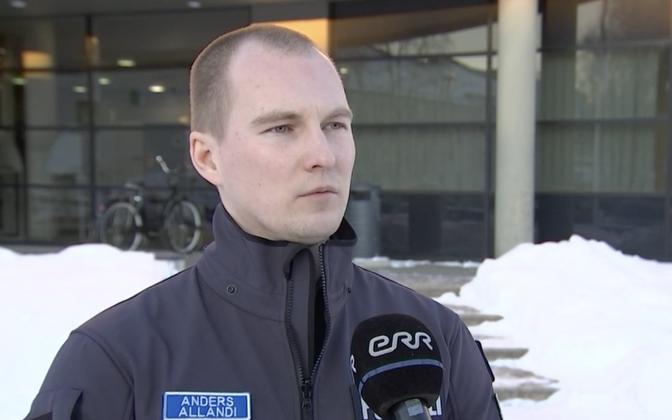
The police have also noticed a clear rise, confirms Anders Allandi, head of the Ida‑Harju proceedings unit.
"Everything starts with simple and accessible buildings, like the music high school, the Liivalaia courthouse, some other abandoned building that is visible and known to everyone. From there it moves to more extreme. For example some kinds of masts, excavators, building roofs," he said.
According to Marko Künnapas, sales manager of the Riigi Kinnisvara (RKAS), their portfolio contains across Estonia about 600 properties with altogether around a thousand buildings. Among them is the music high school complex in Kivimäe, Tallinn, which has stood mostly empty for about ten years and consists of five buildings. A large number of break‑in and rampage videos have been recorded there. RKAS has indeed made efforts to protect the buildings, and at the dormitory one can even read young people's "feedback."
"The headache is that this involves resources that are spent on it, and it involves costs, and these costs per site can reach tens of thousands," said Künnapas.
The videos show a clear dynamic: when the first break‑in has occurred and becomes known, a mass invasion and decline follows. For example the former Viisnurk factory in Pärnu, where skis were once produced.
"At some point all the security systems were broken there and basically the entire archive contents were thrown down from the fourth floor into the stairwell," said Jan.
Or the once popular Mereranna sanatorium in Narva‑Jõesuu. "Where actually at the beginning of this year everything was still quite in order, they broke in, smashed all the security there and in just the past summer there were a whole 14 fires," said Raigo.
Because social media requires public sharing, paradoxically the pranksters themselves document their crimes. There are videos where a crowbar, an angle grinder is used or a hole is smashed in a stone wall with a hammer. A vivid example is the Soviet‑era shelter in Õismäe. In the end the owner had no choice but to place multi‑ton concrete elements in front.
In the videos there is also quite a bit of teasing owners, security firms and even the police.
"In places where there is security, they have a so‑called five‑minute rule, meaning within five minutes you basically have to be gone from the site. You have to be able to run through the building with sirens blaring," said Raigo.
Allandi admits that probably only a fraction of cases reach the police, but when they do, it is formally a break‑in, which is a misdemeanor and may involve a fine. If the break‑in perpetrator is under 14, the matter usually ends with a conversation with the culprit and their parents.
A separate issue is that for damaged property a civil claim may also threaten. One thing is financial damage, but everyone highlights the physical dangers, which begin with mold, inhaling which is harmful, up to the possibility of falling to one's death. In one music school video, for example, a boy trips and flies through a door glass.
One thing is young people's risk behavior, but lately more and more videos have come from sites that can be called vital infrastructure. For example a clip from the end of August, where a masked group breaks into the Valgjärve television and communication mast.
It is still light outside and one worker's car stands in front of the building, but at the same time the guys stroll on the roof. In the end the intruders admire the sunset 350 meters above ground at the top of the mast, through which among other things ETV's picture is transmitted into many homes.
It is also noticeable that urbex enthusiasts have clearly climbed, without owners' knowledge, for example to the top of the chimney of the Iru thermal power plant, accessed the Paldiski nuclear storage, Tallinna Vesi and several Eesti Raudtee sites, which should be quite well guarded.
Just last week a video was posted of how a stranger climbed in the dark into the crane cabin at the Rail Baltic terminal construction in Ülemiste. Experts warn that on the one hand in the current era of hybrid war videos may provide information, on the other hand hotheads may be used for some mischief.
"I think that danger may be great, we actually see in the context of hybrid war very many acts that we could not yet yesterday think of in hybrid war. These acts develop at tremendous speed and all the more we ourselves must be careful how or what we do," said Allandi.
--
Editor: Marko Tooming, Argo Ideon
Source: ERR "Pealtnägija"