Liisa Talving: Estonians have more faith in democracy than in the government

Estonians believe democracy is functioning better than the current government. That is not necessarily bad news: democracy is healthiest when people trust the system itself while maintaining a critical view of those in power, writes Liisa Talving.
On average, people in Estonia rate the functioning of democracy at five points out of 10, while the government's performance receives a rating of 3.8. The gap points to an important distinction: disappointment with day-to-day politics does not automatically mean disappointment with democracy itself. In a democracy, dissatisfaction with the government can be natural and even necessary because it pressures politicians to respond to public expectations.
Democracy can be strong even when people dislike the government
Satisfaction with the government's performance is characterized by a high level of dissatisfaction: more than one in five respondents, or 21.7 percent, said they were not satisfied with the government's work at all. Yet more than half rated the functioning of democracy at five points or higher on an 11-point scale. This is generally a positive combination for democracy. People view the political system itself as legitimate but expect politicians to do a better job and can express that expectation through their voting decisions.
The 2026 LongEstWell survey included 5,933 Estonian residents aged 18 and older. Respondents were asked to evaluate both the functioning of democracy in Estonia and the government's performance on a scale from zero to 10. Satisfaction with democracy reflects a broader and longer-term assessment of the political system, while satisfaction with the government depends more heavily on the politicians currently in power and therefore changes more quickly.
Compared with Europe, satisfaction with the government is low in Estonia
A broader comparison shows Estonia in the middle of the pack among European countries when it comes to satisfaction with democracy. According to data from the 2023–2024 European Social Survey, Estonia's average rating was 5.1 out of 10. The highest ratings were recorded in Switzerland and the Nordic countries, while the lowest were found in several Central and Eastern European states.
Satisfaction with the government's performance, however, is significantly lower than the European average. With a score of 3.4, Estonia ranks in the lower part of the European comparison. Only Croatia, Latvia, the United Kingdom, Bulgaria and Ukraine rank below Estonia.
Over the past 20 years, assessments of democracy have remained relatively stable in Estonia. Satisfaction with governments has fluctuated more, declining during the economic crisis and again during the fall and winter of 2024, when tax increases, rising prices and the cost of living dominated public attention.
The biggest divide runs along ethnic lines
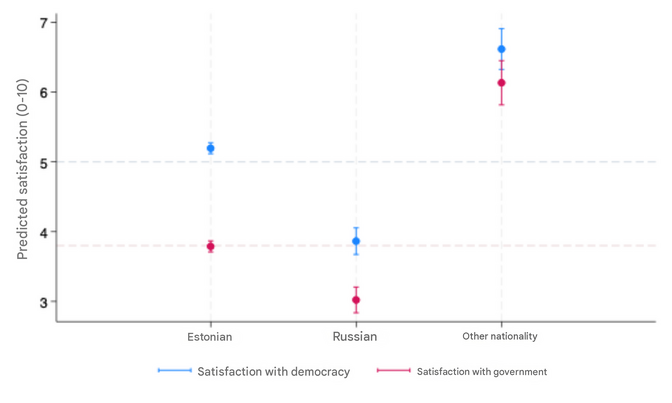
The most notable differences in political satisfaction appear between ethnic groups. Ethnic Estonian respondents rated the functioning of democracy at an average of 5.2 points, while ethnic Russian respondents gave it only 3.9 points. Respondents of other ethnic backgrounds averaged about 6.6 points. The pattern is the same for government performance, though the differences are smaller.
This is not simply a question of whether people like the current government. Political evaluations among ethnic minorities in Estonia are consistently less positive, and these differences have become even more pronounced since Russia's full-scale invasion of Ukraine. A lower assessment of democracy may indicate a feeling that the political system does not represent an individual's interests or sufficiently hear their voice. For that reason, the gap between ethnic groups is an important indicator of democratic health.
Middle-aged people are the most critical of politics
Political satisfaction is also influenced by age, education and economic well-being. Younger people tend to be more optimistic about politics. Satisfaction declines in middle age, when people interact most frequently with the state and its institutions and face the greatest economic and family responsibilities. Satisfaction rises again among older age groups. This pattern is especially clear in evaluations of the government's performance.
Women, people with higher levels of education and those who are economically better off also tend to be more satisfied with politics. This means political satisfaction is not distributed evenly across society.
Estonia's main challenge is not that people expect more from the government. A critical electorate is a normal part of democracy. The bigger question is how to ensure that people of different backgrounds and native languages feel equally that democracy works for them. This matters because faith in the political system affects people's willingness to participate in society, follow shared rules and support the long-term stability of democracy.
--
Editor: Jaan-Juhan Oidermaa, Argo Ideon


