Outgoing Chancellor of justice questions bird protection data quality

Chancellor of Justice Ülle Madise says the Environment Agency has registered protected bird species in Estonia's nature database on incomplete evidence.
This has created buffer zones in places where the species does not live, Madise, who from next week will be President of Estonia, went on.
Madise has raised the issue with the Environment Agency (Keskkonnaagentuur), the Ministry of Climate and the Riigikogu's environment committee. The agency says work to improve data quality is underway.
Madise said her adviser reviewed several materials underpinning EELIS, the Estonian nature information system, at the Environment Agency, and found that information on species occurrence was often sparse.
"For example, there is only the confirmation concerning the person submitting the information that they saw or heard a representative of a specific bird species in the area," Madise said.
According to the outgoing justice chancellor, the Environment Agency has no agreement with experts or clear rules on what kind of information must be submitted and how it should be formatted for an entry in the information system to be sufficient. For example, photos and recordings are usually not submitted to the database.
Madise noted that the absence of such information does not necessarily mean an observation is unproven, and current practice shows that even when photos are submitted, they can be uninformative — for instance, a picture of a bird feather is submitted, but it is photographed edge-on, making it essentially unviewable.
"The thoroughness of the description of a find is also uneven. For example, it may state that there is one chick in a nest, but it is unclear whether it was observed with binoculars, a drone, or by climbing the nest tree. It therefore remains unclear under what observation conditions the presence and number of chicks was established, or whether only the opinion of the person submitting the information about nesting and the number of chicks was presented," Madise went on.
According to Madise, it is commonplace for the individual who identified a specimen to simply notify the Environment Agency that they saw a representative of the species in question, without adding any other evidence. The reliability of such information should nonetheless be assessed, she said.
Madise also pointed out that the Environment Agency assesses the credibility of information received mainly by considering the person submitting it, and if the data submitter is an expert in the field, their confirmation alone is sufficient that the species nests there. The materials should also include the circumstances of the observation and the reasoning on which conclusions were drawn and the extent of the habitat determined, she said, because otherwise it is difficult to verify conclusions and resolve landowners' objections.
Madise described what emerged during the proceedings: When an eagle's nest is discovered, for instance, not only the nest tree but also the species' habitats or find sites are entered into the database, creating in effect two different protection zones around the nest tree. The nest tree is surrounded by a legally defined circle with a diameter of 50 to 1,000 meters, but in addition the Environment Agency has created a buffer zone whose size the agency has set at its own discretion, according to Madise.
The buffer zone may be several dozen hectares and may be created around the nest of a bird species for which the law does not directly provide protection.
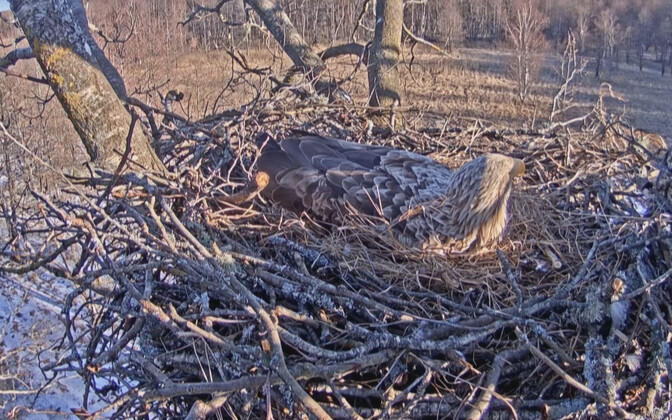
There have also been cases where the Environment Agency has created a find site in EELIS at its own discretion, including a buffer zone, where an area is thought to be suitable for nesting for a bird species whose nest or nesting has not been identified in that specific place, Madise said.
"As a result, a landowner may currently find themselves in a situation where the Environment Agency applies extensive restrictions (covering dozens of hectares) on their property on the basis of an entry of merely informative significance, whose accuracy — that is, active nesting — the agency does not assess before imposing the restriction in each case."
Madise added that if a buffer zone is marked on the map layer in addition to the nest circle, then forest felled from that area may be considered timber felled from an area subject to nature conservation restrictions, whose use conflicts with the conditions of the forest management certificate used in Estonia.
"If the state makes an entry in a database about the nest of a rare bird species and then marks an area where activity may disturb the bird, it would be hypocritical to claim that entries made by the state should not be taken into account in timber certification, because the Environment Agency does not consider them legally binding," said the chancellor of justice.
Conservation chief: System needs tidying up
Roland Müür, head of the Environment Agency's nature conservation service, told ERR that EELIS is a database containing data collected through expert assessments, fieldwork and research projects, mostly commissioned by the Environment Agency. A database of this kind helps identify places where the protection of natural values must be considered when organizing human activity.
"The chancellor of justice is absolutely right that environment decisions must be based on information that is as accurate and verifiable as possible. This is important in both directions: that a protected bird does not remain without necessary protection, and that a landowner does not face unjustified restrictions," Müür said.
According to Müür, the Environment Agency therefore does not limit itself to trusting EELIS data in important decisions, but gathers additional information through expert assessments, fieldwork, remote sensing or even impact assessments.
"At the same time, work is also underway to improve the data quality of EELIS itself. We have already significantly tightened the principles for commissioning, documenting and verifying inventories ordered by the Environment Agency. In today's inventories commissioned by the agency, competence requirements for experts are already set during the procurement process, and the quality of data received is checked before use," Müür said.
EELIS currently has nearly 100,000 entries, and Müür noted that some were entered at a time when habitat boundaries were drawn on the map, figuratively speaking, with a colored pencil. EELIS information is constantly being refined and organized; last year, for example, more than 14,000 entries were tidied up, including thousands being archived.
"It is regrettable if it has nonetheless happened that a restriction somewhere has arisen on the basis of incorrect data. We will certainly analyze this case and the chancellor of justice's thoughts separately. But information on natural values that is as accurate and clear as possible is in the interest of nature conservation, the landowner and the Environment Agency alike," added the head of the agency's nature conservation service.
--
Follow ERR News on Facebook and Twitter and never miss an update!
Editor: Karin Koppel, Andrew Whyte