Minister: Estonia does not support EU's private chat monitoring policy

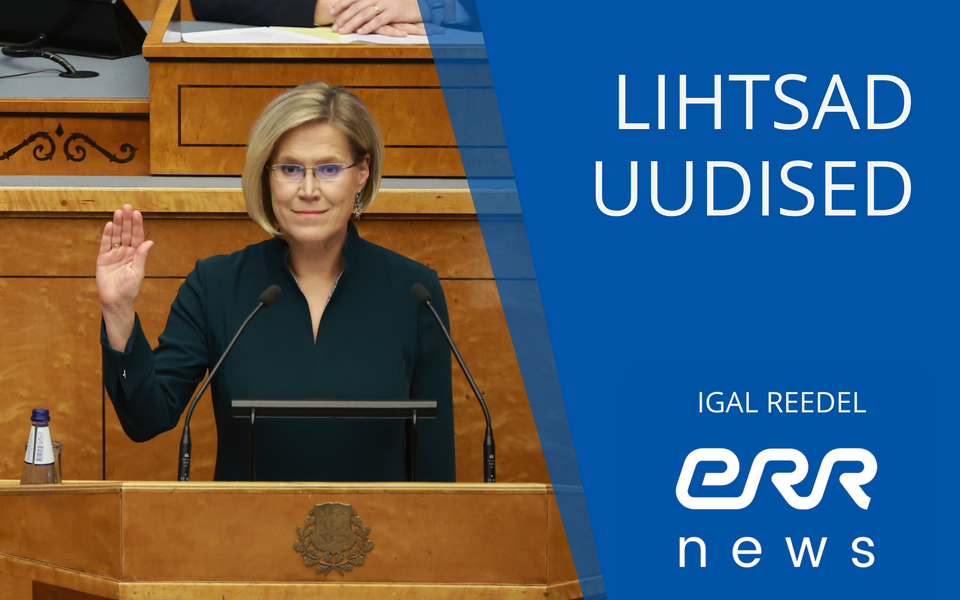
Education Minister Kristina Kallas (Eesti 200) said Estonia does not support monitoring chat messengers of private internet conversations currently under discussion by the EU.
The new legislation is part of a new child protection-focused law and has been discussed by policymakers in Brussels for over three years.
In its current revised form, the law would allow messaging apps to voluntarily scan the content of conversations to prevent the spread of material depicting child sexual abuse and the grooming of children. It would also require platforms to do more to detect and remove such content.
A previous version suggested all content should be monitored. However, critics say the law infringes on individuals' privacy.
The European Parliament is expected to vote on the proposed law in April.
"This is a discussion taking place in the European Parliament. Estonia has presented its position there. Estonia's position is that we do not support it," Kallas said at the weekly government press conference in response to a visiting student who asked whether chat control would be adopted.
Government supports law in its current form
Interior Minister Igor Taro (Eesti 200) said in December that although Estonia supports the regulation, the government opposes any monitoring obligation.
"Estonia's position on the regulation to combat child sexual abuse has not changed. Estonia does not support any solution that would create a general monitoring obligation or force service providers to break into encrypted communication environments. We have said this repeatedly and explicitly, and these principles will remain in place going forward," Taro said at the press conference.
He emphasized that the willingness to move forward with the draft stemmed from the fact that its previously problematic parts had been substantially revised.

"The most important point is that the obligation to detect all user content, especially encrypted communications, has been completely removed from the draft. That was a red line for Estonia, and that is why it was not possible to support the earlier version. Since this requirement has now been explicitly removed, the draft is no longer in conflict with the government's previous principles," the interior minister noted.
He stressed that the amendments are sufficient to eliminate earlier privacy concerns.
"No mass surveillance or requirement to break encrypted messages will be introduced. Any possible detection obligation in the future has been placed solely under a review clause. Nothing will enter into force automatically, and it would require a new political decision among all member states," Taro said.
MEPs' positions are divided
When ERR asked Estonian members of the European Parliament for their views in December, their positions were split. Center's Jaak Madison and Jana Toom oppose the law in any form, while Marina Kaljurand (SDE) and Jüri Ratas (Isamaa) support the amended form. Sven Mikser (SDE) and Riho Terras (Isamaa) have not yet formed a final position.

"I am completely opposed to this draft, because essentially they are still trying, 'in the name of protecting children,' to gain oversight of the activities of every ordinary person. Such a surveillance society is common in China, but now a similar system is being built in Europe," Madison said.
He added that the argument of protecting children is a smokescreen, and the real aim is to control people's activities.
Madison said he does not understand the interior minister's change of direction or its justification.
"Mr. Taro claims that the revised draft no longer includes blanket monitoring of every internet user, but there is still an obligation for companies and websites to carry out profiling, and those who fall into a certain 'profile,' even if they have done nothing illegal, may still unknowingly come under surveillance," Madison said.

Toom likewise said she does not agree with the interior minister's position, since the European Council's stance still allows platforms themselves to monitor message exchanges.
"The parliament's position, which I also supported, was clear: the content of messages may be checked only with a court order and only when it is the last possible measure. And this cannot be done in the case of encrypted messages," she said.
Kaljurand noted that the latest version of the law does not amount to blanket monitoring.
"I support the presidency's current proposal mainly for two reasons: end-to-end encryption remains in place, this has been reiterated in several places. Therefore, mass or blanket monitoring does not apply, but voluntary, justified and risk-based targeted checks will continue, which are already being applied in practice today. In other words, digital privacy is preserved," she said.

Ratas also said that the latest amendments do not include a monitoring obligation.
"My personal position has been and remains clear: I do not support solutions that would create a general monitoring obligation or open the door to scanning everyone's communications, including in encrypted environments. The latest amendments to the draft have been very extensive and remove precisely the problem that Estonia has also opposed," he said.
Mikser and Terras are still forming their positions.
"One of the key criteria I will consider in making my decision is, of course, that the new regulation must not result in blanket monitoring of all digital communication once it enters into force," Mikser said.

Terras noted that the original version of the European Commission's draft was highly problematic.
"Child pornography is a serious issue and must be addressed, but the measures to combat it must be proportionate. We cannot preemptively open everyone's personal communication channels and messages to mass monitoring. That would essentially mean that all citizens are already suspects," he replied.
"I can give a final assessment once there is an agreement," the MEP added.
ERR was unable to obtain a comment on the matter from MEP Urmas Paet (Reform).
--
Follow ERR News on Facebook and Twitter and never miss an update!
Editor: Valner Väino, Helen Wright