Estonia lost €233 million to 'phoenix' company schemes, watchdog says

About €233 million has gone unpaid by roughly 600–650 companies in three and a half years, the head of the national insolvency service says, following a rise of phoenix schemes.
In some cases, thousands of company names, which often form part of an international network, have been registered to a single address.
The service and bankruptcy trustees say the practice is openly sold, with struggling firms handed to stand-in directors, moved abroad or parked at addresses hosting hundreds of debtors.
A phoenix scheme, known in Estonian as "company burial," sees the same business transferred to a new company, then another and on and on. While each company becomes insolvent, its debts are not carried to the next firm.
Signe Viimsalu, who heads the Competition Authority's (Konkurentsiamet) insolvency service, said the picture is worrying: the business register holds more than 300,000 private limited companies, 20 percent of them problematic in some way, and 20,000 legal entities currently have no management board member at all — no one to represent them, supervise them, or file a bankruptcy petition on their behalf. "A company simply drifts," Viimsalu told "Pealtnägija".
Viljar Kähari, a bankruptcy trustee, described the pattern: tax debts, enforcement notices, missing annual reports — then all of a sudden a new board, a new address, a new owner, and a beneficial owner abroad whom nobody can trace.
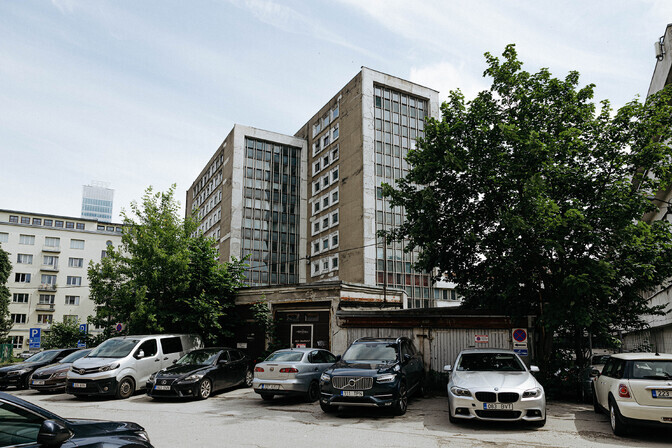
An address at Rävala pst in central Tallinn has had 1,261 companies associated with it deleted from the register, and a related €13 million approximately in tax debt, according to public data. Another address, Sepapaja 6 in Lasnamäe, ironically right next door to a Tax and Customs Board (MTA) office, has more than 5,000 companies registered to it; 1,185 apparently operate on paper from a three-room flat on Sakala tänav, again in downtown Tallinn.
One route leads south to Bulgaria. A company burial agent has been advertising the transfer of struggling firms there, and several apparently respectable owners have used it: bicycle insurer Bike-ID, which once earned praise from the police, is now registered at a Soviet-era block in the Bulgarian city of Plovdiv and owes the Estonian state nearly €100,000. Teet Torim, a former TalTech lecturer who presents himself as an AI expert, has had two companies, with their tax debts, registered at the same building.Meanwhile a staffing firm Laki Haldus, which lacked the authorization to supply temporary workers and owed €50,000, is registered in Bulgaria too.
What connects the three is that in every case the sole management board member is now Rando Saarepere — the same man, at the same address, but for three unrelated businesses. According to the business register, more than 700 companies with associated tax debts over €6 million have passed through his hands under similar circumstances, which is what makes this a pattern rather than three coincidences. Saarepere did not respond to "Pealtnägija." The notary who handled the transactions, Märt Paberit, said he had never met Saarepere in person, adding that the law contains no explicit grounds preventing the transfer of indebted companies.
Viimsalu and trustee Toomas Saarma argue burial achieves little: it does not remove liability, and the state fee for a bankruptcy petition is lower. "If you are a business owner with no money personally and none in the company, file for bankruptcy and put an end to the ordeal," Viimsalu said.
What is company "burial"?
A phoenix company involves the practice of carrying on the same business through a succession of companies, each of which becomes insolvent in turn, with the business — though not the debts — which are transferred to a new "phoenix" company arising from the "flames". Company burial (firmamatmine) is the Estonian term for the same mechanism, where a debt-laden company is handed to a stand-in director, moved to a new address or sold abroad, and left to drift or be deleted from the register. This is distinct from a shell company, a legal entity with no or nominal operations and few or no assets, and whose main feature is its ability to conceal the identity of its true owner.
--
Follow ERR News on Facebook and Twitter and never miss an update!
Editor: Andrew Whyte, Johanna Alvin
Source: 'Pealtnägija,' reporter Heliis Raudsik.


