Why are laundromats becoming more popular in Tallinn?
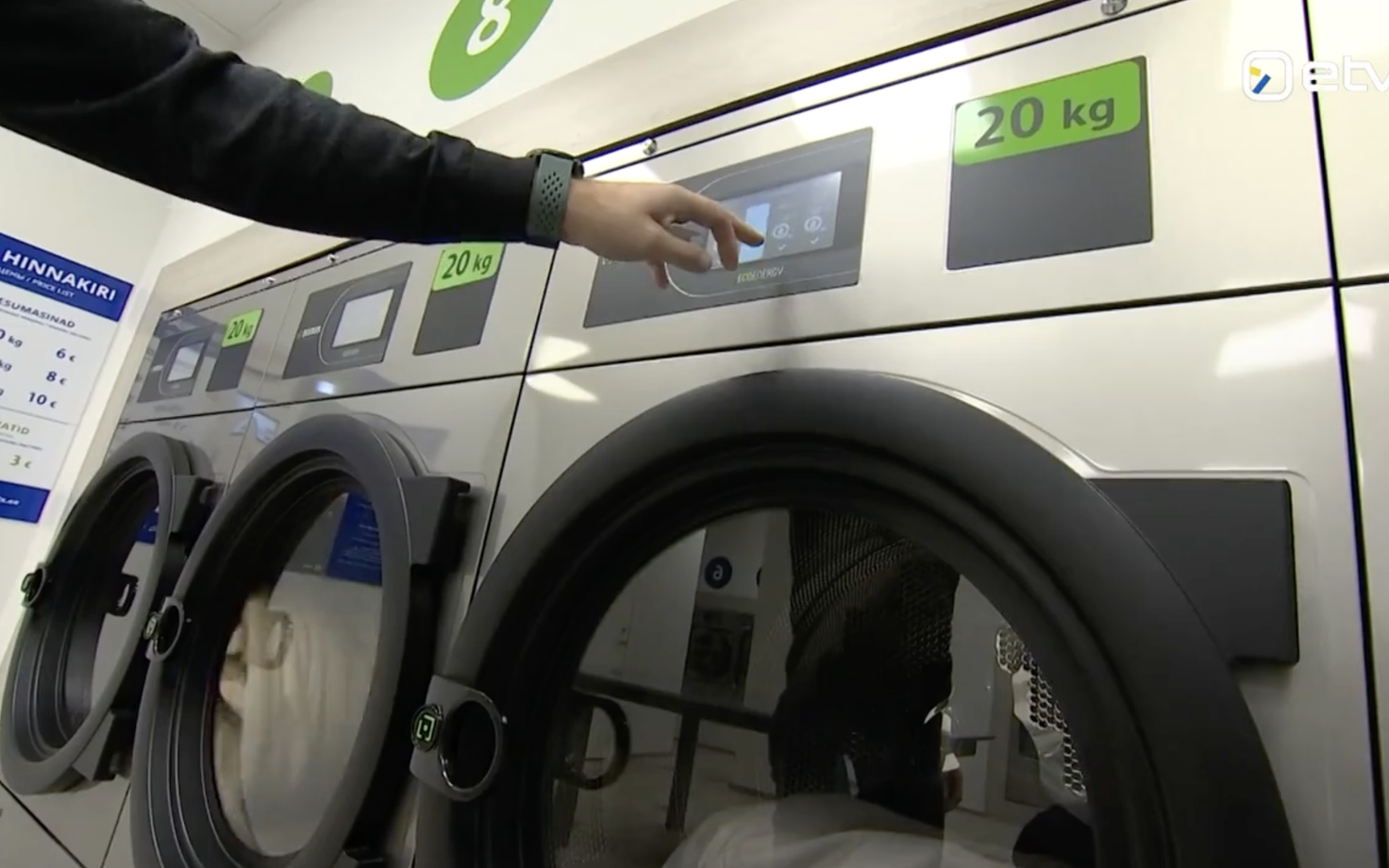
In Estonia, it is generally not customary to wash one's dirty laundry in public, but suddenly a whole string of self-service laundromats has appeared in Tallinn. Although there are hardly any homes without a washing machine, ERR investigated why people no longer want to do their own laundry at home.
The first self-service laundromats opened 60 years ago, when many people still had their water supply outside and wastewater indoors. The Riga washing machine, which constantly gave electric shocks, was an unattainable dream for many housewives.
Laundromats died out several decades ago, when automatic washing machines went from being luxury goods to everyday household appliances. However, recently, new self-service laundromats have sprung up in the capital like mushrooms after rain.
Is the trend connected to the changing size of apartments, ETV's evening news show "Aktuaalne kaamera" asked?
Ingmar Saksing, a member of the management board of LVM Real Estate, told the show: "There is some truth to that, apartments are indeed getting smaller and smaller. But just because an apartment is getting smaller does not mean that dirty laundry cannot be washed at home. We have reached a point where people have little time. They increasingly dislike mowing the lawn themselves, robots do it; robots also clean many people's homes, and doing the laundry has remained a tedious chore."
Saksing said there are few homes without a washing machine. If there is not enough room for one in the bathroom, it is hidden under the sink or built into the kitchen furniture.
Even if a corner can still be found for a washing machine in the bathroom, problems can arise when it comes to drying clothes – where do you put a drying rack in such a small apartment? Clotheslines between apartment buildings have been replaced by parking spaces, and attics have become penthouse apartments.
"If you do not have a balcony, you do not want to turn your home into a laundry drying room. That's the reason," Saksing said.
Aljona, who lives in Mustamäe, has both a washing machine and a dryer at home, but still prefers to visit the laundromat.
"It's more convenient here because it takes less time. Washing bed linen at home takes two to two and a half hours, but here it's done in half an hour. You load the machine, go shopping, and when you come back, everything is already done," Aljona told the show.
Drying takes 15 minutes, while at home the machine would rumble away for an hour and a half. Laundry can be washed so quickly because the machines do not waste time heating water.
However, if you add the time spent going to the laundromat, the question arises whether washing one's dirty laundry in public actually saves any time at all.
"Since there are more machines here, and they are bigger, you can put more laundry in, so you could say it gets washed faster. I sometimes come here to do the laundry myself. You could say I'm buying my wife time," said Mairo Matsi, a member of the management board of laundromat chain Laundrix.
Kristiina Lõhkivi, a representative of the company Laundromat, said the main customers of self-service laundromats are single men, who struggle to understand which cyle to pick, and mothers.
"These are our main customers, who have more laundry, large items, such as blankets and pillows, which you otherwise could not fit into a machine at home, but which fit into ours very easily," Lõhkivi said.
She said domestic washing machines are considerably less efficient than industrial models, unless you have bought a machine costing several thousand euros.
"If you have a machine that costs €4,000, then the only thing we can offer you is saving time," she said.
The most popular time to visit the laundromat is at weekends or later in the evening, from 10 pm to midnight. A quarter of customers bring wet laundry to dry.
--
Follow ERR News on Facebook and Twitter and never miss an update!
Editor: Helen Wright, Marko Tooming
Source: Aktuaalne kaamera


