Archival studies shed light on sunken steamer's fate in Estonian waters

The wreck of the cargo steamship Success, which sank in Estonian waters in 1885, is among 15 shipwrecks newly placed under state protection to preserve Estonia's underwater cultural heritage.
More than 100 underwater heritage sites in Estonia's maritime areas are under state protection. Another 15 shipwrecks have now been added to the list. According to underwater archaeologist Maili Roio, conditions in the Baltic Sea have helped preserve shipwrecks, but that alone is not enough.
"We're actually in a very good position here on the Baltic Sea because the sea itself does an excellent job of preserving our shipwrecks. However, our maritime areas are being used increasingly intensively and for a growing range of purposes. The state must therefore ensure that underwater cultural heritage is taken into account when planning activities," Roio explained on ETV morning show "Terevisioon."
The newly protected sites include the wrecks of 12 sailing ships, the destroyer S31, a steamship and the cargo steamship Success. Four are located in internal waters, nine in territorial waters and two in Estonia's exclusive economic zone. All the wrecks are sufficiently well preserved to serve as important archaeological sources of historical information.
Placing a shipwreck under protection does not mean that the surrounding maritime area can no longer be used. However, certain restrictions apply in designated areas and must be taken into account. When a wreck and its immediate surroundings are protected and a buffer zone has been established, planned activities must take into account the need to preserve the wreck. For example, wind turbines should be installed far enough away from a wreck to ensure that construction work does not damage or destroy it.
Although the 15 newly protected wrecks represent a significant addition, Roio said they are just a drop in the ocean. The Estonian Transport Administration conducts seabed surveys every year, uncovering new wrecks in the process. However, not every wreck is automatically granted protection.
"We can't simply place a wreck under protection as soon as it's been located. We need preliminary information from the seabed: what kind of wreck it is, how well it has been preserved and what information it might contain," Roio said.
One of the newly protected wrecks lies at a depth of more than 60 meters. It caught the attention of underwater archaeologists because of its shape and dimensions. The wreck resembled a willow leaf: It was relatively narrow and elongated, suggesting that it could be an older vessel.
According to preliminary estimates, the wreck dates from the 16th or 17th century. Researchers examined footage captured by an underwater remotely operated vehicle, allowing them to study parts of the ship without immediately undertaking more complex underwater archaeological work.
Roio said the footage shows only a small portion of the wreck. Two masts are visible, indicating that it was a two-masted sailing ship. However, the parts of the wreck visible on the seabed do not provide a complete picture of its condition.
Further research is needed to establish the wreck's precise age and origin. There is currently no definitive information about the ship's history or whether it can be linked to written historical records.
The depth also makes research more challenging. Archaeological excavations are more difficult at depths exceeding 60 meters, although they could help determine what other archaeological material the wreck contains.
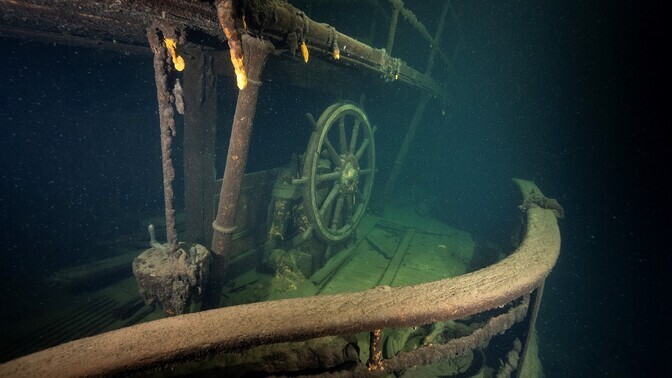
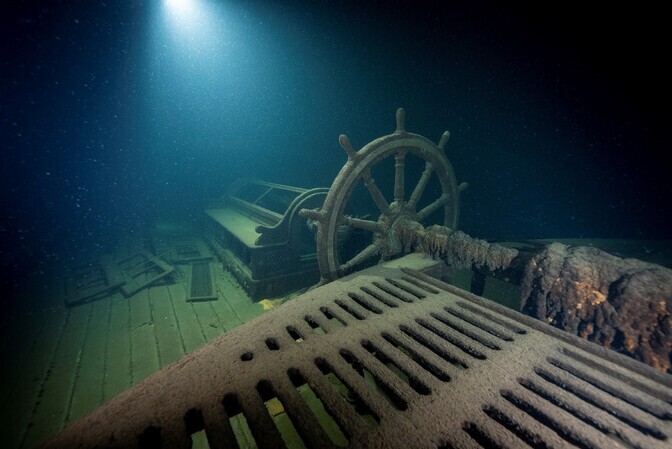
Another newly protected wreck is more recent and better preserved than the first. It is a sailing ship dating from the 17th or 18th century, with parts of its structure rising several meters above the seabed. Both its anchor windlass and a large gaff boom are visible. In this case, researchers were able to go beyond examining the wreck on the seabed and connect the discovery with earlier archival research.
According to Roio, underwater archaeologists worked with the National Archives of Estonia to gather information about sunken vessels. Information found in archival records helped establish the history of one wreck, identifying it as the cargo steamship Success.
The ship was traveling from Kronstadt to London when it sank in Estonian waters in July 1885. It had previously run aground in the Gulf of Finland and sustained damage. To get the vessel moving again, some of its cargo was thrown overboard. Roio said the cargo steamship's wreck is well preserved, although it has sustained some damage.
Roio described the 19th century as a fascinating period of transition in shipbuilding and maritime navigation. The introduction of steamships transformed shipping, but steam-powered vessels continued to use sails. Masts are also visible on this wreck, offering insight into how different maritime technologies coexisted.
"This transitional period is really fascinating. At the same time, the ship still has those beautiful lines characteristic of sailing vessels. It must have been a very beautiful ship," Roio said.
According to Roio, the Estonian Maritime Museum initially suspected, based on sonar images and the dimensions of the wrecks, that they might be warships. Only additional information gathered from the seabed can establish what the vessels actually were.
A third example is the wreck of a 19th-century sailing ship that still has its figurehead, a decorative feature attached to the bow. The survival of such details is remarkable because they are often among the first parts to break off or suffer damage from trawling.
Roio said trawling has long been one of the main activities responsible for damaging shipwrecks in Estonian waters. It is therefore particularly unusual to find a vessel with such details still intact, as they provide valuable clues about the ship's original appearance and construction.
Placing shipwrecks under state protection also helps Estonia fulfill its obligations under UNESCO's 2001 Convention on the Protection of the Underwater Cultural Heritage.
--
Editor: Marcus Turovski, Sandra Saar
Source: "Terevisioon"


