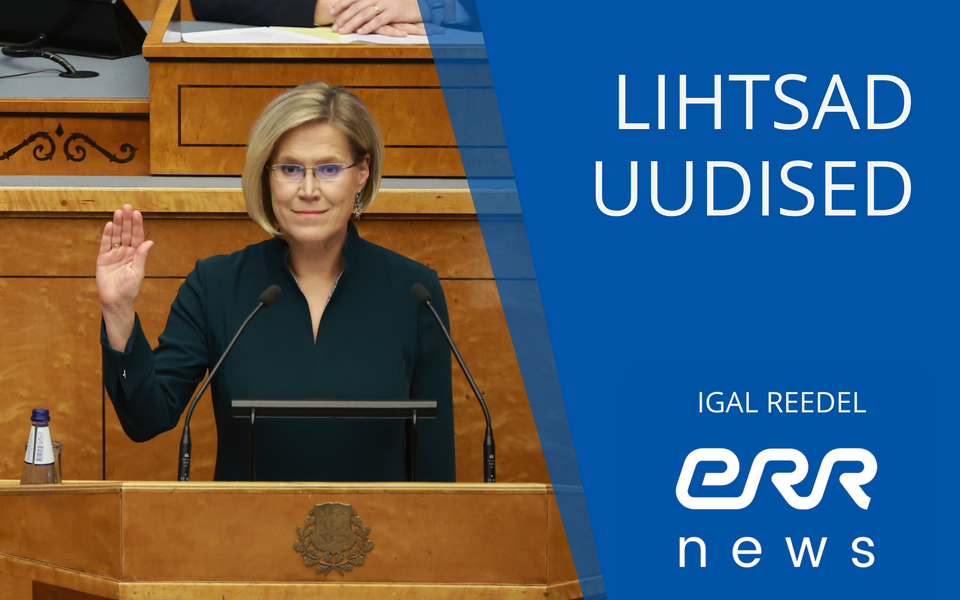
Who is Estonia's new President Ülle Madise and what does she think of life?

On Wednesday, Estonia's parliament elected 51-year-old lawyer and longtime Chancellor of Justice Ülle Madise as the new president of the Republic of Estonia. The public, however, knows relatively little about the new head of state and her views on life in Estonia.
A graduate of the University of Tartu's School of Law, Madise has had a distinguished career in Estonia's state administration, heading several government bodies and carrying out major reforms over the past 30 years. In the early 2000s, for example, as head of the Ministry of Justice's legislative policy department, she helped introduce Estonia's online voting system and several years later, as head of the secretariat of the Riigikogu Constitutional Committee, she helped transpose European Union legislation into Estonian law.
A lawyer known for her clear manner of speaking and extensive knowledge who became one of Estonia's best-known constitutional law experts through her media appearances, Madise caught the attention of President Toomas Hendrik Ilves, who hired her as his legal adviser in 2009. During the so-called Ice Cellar process, many noticed how heavily Ilves relied on her and Madise came to be regarded as the president's right-hand woman.
"It was entirely understandable that she would be there because the issues were constitutional and legal. At the time, there were major protests against the government's actions. So of course you bring your legal adviser along as your right-hand person," then-President Toomas Hendrik Ilves recalled, confirming Madise's influence within his office.

In January 2015, Madise was chosen as Estonia's first female chancellor of justice. She is now in her second term and has held the position for 11 consecutive years. One indication of her standing in society is that as early as fall 2016, when the presidential election failed to produce a winner through several rounds of voting in parliament and ultimately in the Electoral College, Madise's name was also floated as a possible candidate.
Ilves said he already believed at the time that Madise would make a good president, although in his view she was still too young for the office then. Madise herself said she was not yet thinking about becoming president at the time.
Madise defends the Constitution and human rights, but she also speaks out boldly on matters of political choice. She has criticized excessive government bureaucracy, the Police and Border Guard Board's use of license plate recognition cameras and government agencies' desire to snoop through private individuals' banking data. Former State Secretary Taimar Peterkop said some of the sharpest disputes within the government took place during the COVID-19 pandemic.
Because Madise was quick to defend fundamental rights and freedoms, many were left with the impression that she was opposed to vaccines. That perception was reinforced by an episode involving a mask — or, more precisely, the absence of one. A photo from spring 2021 shows her posing alongside President Kersti Kaljulaid who was wearing a mask. Asked by a journalist why Madise was not wearing one, she replied: "Because I can't be a hypocrite. Before that, we'd spent an hour and a half talking without masks, eating and laughing. Neither of us had symptoms or COVID."

Madise said this did not mean she considered Kaljulaid a hypocrite. "No, I'm not criticizing anyone. People have different convictions and, indeed, the photographer told me to put on a mask as well, but I said I didn't think it was appropriate in that situation because it could also give people the impression that a surgical mask helps under COVID restrictions or protects against COVID. A surgical mask does not prevent the spread of the coronavirus. That has been established."
According to Madise, her character simply does not allow her to go along with things like that.
"I saw those people who thought, for example, that they didn't need to get vaccinated or that they could go out while showing symptoms of illness as long as they were wearing a surgical mask. And then you have to explain that if you have symptoms, you must not go out because the person across from you could have cancer or could be someone who dies because of you. /…/ So that was one aspect of it: It was simply my duty not to go along with the power of that symbol and I certainly don't criticize anyone who felt it was a sign that could help keep society's awareness of the danger high."
Peterkop, who worked closely with Madise at the time, recalled being pleasantly surprised by her empathy. "How she noticed when someone was having a hard time and how she helped that person — I've experienced it myself. I've seen it with others as well: She supported my colleagues, the employees of the Government Office. She would go and talk to them directly and, so to speak, lift their spirits when she saw that someone had become discouraged during those difficult times. So empathy, which is in short supply in our society today, is something I think she possesses to an above-average degree," Peterkop said.
Despite Madise occasionally delivering fairly devastating assessments of Estonia's political culture and the quality of legislation coming out of the Riigikogu, politicians from both the coalition and the two major opposition parties rallied behind her with surprising unanimity this summer.
Ülle Madise's husband is EU Court of Justice judge Lauri Madise who is based in Luxembourg. Given both his reserved nature and his work in Europe, he may take on a role somewhat similar to Georgi-Rene Maksimovski who accompanied Kersti Kaljulaid on official state visits and to Independence Day receptions but otherwise largely stayed out of the public eye.

Madise said her husband is very supportive of her. "My husband supports me very much, just as I support him, so we always try to have each other's backs. At the same time, I think that's entirely reasonable. Nowadays, both people in a marriage can choose their own careers and of course that means making compromises. We've made those compromises, so I hope it will work out, yes," Madise explained.
Asked by a journalist what kind of president Estonia would be getting in her, Ülle Madise replied: "Health and life permitting, I believe a dedicated and hardworking one, while also being down-to-earth. And I have no intention of giving up my belief that we need much more lightness, humor and creativity, so I doubt I'll be overly serious."
Madise declined to criticize the work of previous presidents. "I wouldn't want to say anything that could come across as criticism of anyone and I would say that, in my view, every president has been the right person in the right place at the right time. And I think the president being elected now should try to reduce the areas where people come into conflict with one another," Madise said.
Peterkop believes Estonia will get a good president in Ülle Madise. "Ülle Madise has a very strong academic background. She is a constitutional expert — I think Estonia's most prominent constitutional expert — so she knows very well what the president's role is intended to be," Peterkop said.
Madise said people will be able to count on her as president if a political force that comes to power begins attacking judges, the free press or civil servants, for example. "It's too early to say what I would do, but I have some ideas," she said.
Madise said she is not afraid of the future. "I'm not in the habit of being afraid and fortunately it seems that we're once again in the kind of turbulent situation where I have the opportunity to be one of those at the helm," Madise said, laying out her vision: "That Estonia will be able to choose a path that allows Estonia to remain the kind of place where it's the coolest place to live and to be and where Estonia is still Estonia. That life within Estonia is peaceful and safe, that we have enough other countries prepared to defend us and deter those who might want to attack us from outside. I believe it is possible to steer these processes in such a way that Estonia's future is bright, that this is a place where people want to live."
Turning to Estonia's foreign and defense relations, Madise said international law and defense relations between countries are not a British gentlemen's club, but rather an arena where everyone looks out for their own interests.

"Estonia also has to look out for itself. Estonia can do that by being smart and shrewd and by having very good and powerful allies. That means, of course, maintaining good cooperation with the United States, but also aligning ourselves very clearly with the European Union," Madise emphasized.
Toomas Hendrik Ilves said Ülle Madise also has a good sense of humor. Asked to recall a funny incident, Ilves said: "There have been many. For example, I really liked it when my colleagues once gave me an Allar Jõks hairstyle to put on my head. They'd actually ordered it and brought it in."
Madise relieves stress by exercising, taking walks or joking with her husband, among other things. "Just yesterday we were discussing our godson's training. It was great and we were saying what a handsome young man he is."
Madise understands that in the near future there will be plenty of people offering advice on what she should be like and suggesting things she ought to change about herself.
"I really have heard that I should somehow be prettier and more polished, but to be frank, I am exactly who I am and I don't think I can change that much, nor do I think I need to change that much. When serving as president, you do have to be presentable and proper, but I think that as soon as a person allows themselves to be redesigned into someone else and starts speaking the way people think is appropriate, it becomes artificial. It doesn't come from the heart and it hasn't been thought through," Madise said.
"I don't know how to do that, I won't do it and I don't think I'd be any good at it," she added.

--
Editor: Marcus Turovski, Mirjam Mäekivi