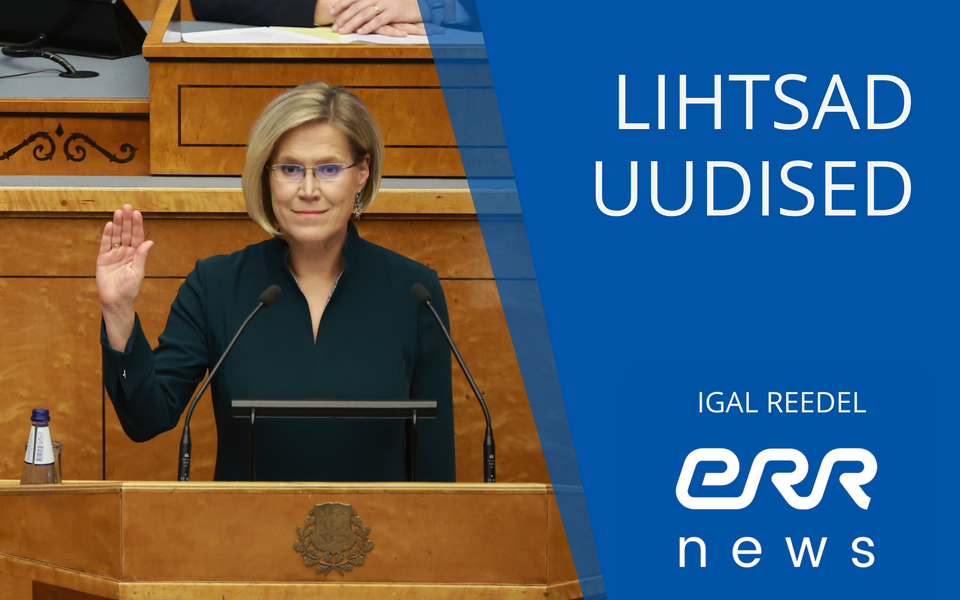
Margus Tsahkna: Estonia's goal is peace in Ukraine, but not Munich or Yalta

Minister of Foreign Affairs Margus Tsahkna said in a speech, outlining the main priorities and objectives of Estonia's foreign policy, that today we are no longer speaking of the end of an era in abstract terms, but of an era having come to an end.
Dear members of the Riigikogu, the diplomatic corps, and honoured guests,
About 12 months ago, I began my speech in this very hall by noting that an air of the 1930s can be felt in the world. When discussing foreign policy at the time, we asked: shall we allow threats to grow until it is too late, or shall we resolutely rally to the defence of our values?
Like many others, we, too, sensed the start of an age of great disruption.
Today, in 2026, people are no longer talking about merely an air of an era ending. They are talking about the end of an era. About how the rules, agreements and customs that were previously in force may no longer apply; about how the old is gone but the new – that replaces it – is still unclear.
"Nostalgia is not a strategy," Canadian Prime Minister Mark Carney said in his speech at this year's World Economic Forum in Davos — and indeed, yearning for the past will not bring it back. Nor would we truly wish to return to it as it was.
During the occupation that spanned half a century, we experienced first-hand what it means to be an exception in the functioning of the rules-based international order. We know all too well that de jure recognition does not lessen the pain of deportation carried out de facto. We understand those who have had to fight for their freedoms in spite of the rules formally in force, and we stand in solidarity with all who point out the contradictions — and at times the hypocrisy — of the existing world order.
A change of eras is neither unprecedented nor extraordinary in world history. It happens that the old gives way to the new. The past is followed by the future, with its own rules, agreements and customs.
This time, Estonia enters a period of change from a uniquely strong position — as an independent state with an experienced foreign service and well-established international relations. Never before has our starting position been so strong.
There is nothing to fear. On the contrary, there is work to be done — and that is precisely what we are doing.
Ladies and gentlemen,
Recognising that the world order is changing, we must begin by addressing the most fundamental question in defining our foreign policy: what is its objective?
What, then, is the objective of Estonia's foreign policy as we approach this period of rupture?
It is freedom — the free development of the Estonian people and state. Freedom at home in Estonia, and Estonia's freedom in the world among other states and nations.
Estonia's freedom is supported by the cohesion of our society and our economic resilience, by military defence and the continuity of vital services — but above all by an international environment that favours our freedom. From this flows the principal task and objective of our foreign policy: we seek international rules that help safeguard Estonia's freedom.
First and foremost, the principles of state sovereignty and territorial integrity are of fundamental importance to us. They must remain the pillars of international life in the future as well. Estonia supports these principles unwaveringly and under all circumstances, and stands ready to back its words with deeds.
The principles of territorial integrity and sovereignty are currently under the most direct attack in Ukraine, where Russia continues to pursue its unchanged objectives: the subjugation of the whole of Ukraine and the overturning of Europe's security architecture in order to reverse the collapse of the Moscow-led empire.
We cannot and will not allow this.
We will keep providing military assistance and political support to Ukraine, and continue our reconstruction efforts and offering humanitarian assistance. In 2027, we will host the Ukraine Recovery Conference, bringing the world's political and economic leadership engaged with this issue to Tallinn. That too demonstrates our commitment. Ukraine can be certain of Estonia, because our policy is not based merely on benevolent altruism. No — this policy stems from the most pragmatic of interests: a free Ukraine aligned with us is an important geopolitical safeguard against Russia's aggressive imperialism.
Let us therefore not think that we support Ukraine only for Ukraine's sake — we do so first and foremost for Estonia's sake. When we speak of our unwavering support for Ukraine's territorial integrity, we are in fact also thinking of the inviolability of our own borders; and when we emphasise the importance of Ukraine's sovereignty, we are demanding freedom for ourselves — the right to choose our allies and to decide our own affairs on our own soil, without external diktat.
The extent to which these principles prevail will largely depend on the kind of peace that ultimately comes to Ukraine. Just as Putin's objectives have not changed, neither have ours: we want peace, but not a peace à la Munich or Yalta. Our aim is a just and lasting peace, as successive Estonian governments have consistently defined it in previous annual foreign policy addresses.
Ukraine has consistently demonstrated that it is ready for peace. Putin demonstrates the opposite on a daily basis. This is understandable: if arguments are constantly heard from the West suggesting that an agreement should be sought now because Ukraine's position might be weaker in six months or a year, then Russia has no rational incentive to accept peace today. This is currently the principal obstacle to a just and lasting peace: Putin's belief that time is on his side.
To achieve a just peace, that belief must be reversed. Only when the Kremlin concludes that time has turned against it will Russia be ready to change course. An effective peace plan, therefore, has two components: increasing support for the victim and increasing pressure on the aggressor.
For this reason, raising the cost of aggression will remain at the centre of our efforts: we will impose new sanctions on Russia and prevent the circumvention of existing ones. As early as February, we seek to approve another European Union sanctions package, including a full ban on maritime services for vessels transporting Russian oil.
Consistency must also characterise our long-term policy towards Russia. Russia is not going anywhere; it will continue to pose a threat to Euro-Atlantic security even if the war in Ukraine were to end. As part of our policy of deterrence towards Russia, we therefore need joint practical measures to contain the threat. One such example is closing Europe's doors to individuals participating in Russia's war of aggression — we do not wish to see today's perpetrators of crimes become tomorrow's tourists on our streets. We call on all European Union member states to cooperate with us in adding Russian fighters to the Schengen blacklist, so that it is unequivocally clear: the only destination in Europe where aggressor fighters are welcome is the dock in The Hague.
Naturally, we also stand by the principles we have previously articulated clearly: nothing about Ukraine without Ukraine, and nothing about Europe without Europe. The latter does not mean striving to sit at every negotiating table; on the contrary, it reflects our firm conviction that matters concerning us must be decided by us. That is the essence of sovereignty. Let me emphasize once again: the problem with the West's Russia policy has not been a lack of dialogue channels, but a deficit of resolve. We do not support the premature reintegration of the aggressor into the global economy, still less into European security.
Honorable members of parliament,
Just as firmly as we wish to carry the principles of territorial integrity and sovereignty into the new era, we wish to leave behind the idea of empire and spheres of influence. We will never recognise any state's right to a privileged zone of interests extending beyond its internationally recognised borders. Nor do we wish to carry into the future a system of de facto impunity, in which an aggressor evades accountability through the use of a veto and the leader who unleashed it shields himself from justice by invoking immunity.
When the aggressor is a permanent member of the Security Council, the United Nations — and the entire system of rules and organisations built upon it — becomes paralysed. Estonia does not seek to dismantle the UN; on the contrary, we wish to restore its credibility. To that end, Estonia has consistently advocated reform of the United Nations. We will also work to ensure that the next UN Secretary-General, to be elected by the end of this year, does not shy away from calling black black and white white.
Insisting on adherence to agreed rules is not idealism. Ensuring accountability is an act of pragmatism: if we seek global stability, violations of rules must have consequences.
Estonia will continue to support the International Criminal Court and to work towards the establishment of a special tribunal for the crime of aggression committed against Ukraine. Last year, we achieved a breakthrough when an agreement was reached within the framework of the Council of Europe to establish such a tribunal. I thank the Riigikogu for recently approving Estonia's accession to the tribunal — this gives us the authority to call on others to do the same. And we intend to do so, as regrettably, the tribunal's actual launch has become bogged down in technical discussions. Estonia recognises that the devil is often in the detail, but we would point out that in the case of the crime of aggression, the devil lies above all in impunity. We must not delay the tribunal's operationalisation any longer. This is not a technical matter. It is a question of the future world order. And we will not accept impunity.
Dear colleagues,
Building an international order that safeguards Estonia's freedom is a major undertaking. Not even a great power can accomplish it alone. We are not a great power. Fortunately, we are not alone either. We have allies who share the fundamental objectives I have outlined — the defence of sovereignty and territorial integrity, the rejection of empire and spheres of influence, and the fight against impunity.
Estonia's closest like-minded partners are here in our neighbourhood — the Nordic and Baltic countries. This so-called NB8 cooperation framework has become the primary coordination format and point of contact for our foreign policy, through which we engage with the wider world together. Collectively, we form the world's ninth-largest economy, we are among the strongest supporters of Ukraine, and we share common positions on almost all fundamental questions of international affairs.
This year, Estonia holds the chairmanship of the Nordic-Baltic cooperation framework, and we intend to use this role entrusted to us not only to coordinate foreign policy but also to strengthen practical integration within our region. Even today, we are one of Europe's most closely interconnected regions, yet the potential for cooperation is far from exhausted. Finland's and Sweden's accession to NATO creates new opportunities for defence cooperation. Our strengths in digital governance provide an opportunity to develop a regional competitive advantage in the age of artificial intelligence. Closer cooperation in culture, education and innovation will help strengthen societal resilience. The aim of Estonia's chairmanship is to translate these opportunities into practical, forward-looking initiatives.
Together with Poland and Germany, all the Nordic and Baltic countries are members of the Council of the Baltic Sea States. Last year, when Estonia held the rotating presidency of this cooperation framework, we jointly decided to place a stronger focus on security within the Council, as our views in this format are virtually identical. This year's Polish presidency has further developed this approach, and our joint efforts are giving rise to a genuine New North: a hub of approximately 160 million people that takes coordinated action.
The New North understands that Europe must rise to its feet. Europe can no longer assume that someone else will solve our problems for us. A weak and fragmented Europe cannot safeguard our freedom nor resist the idea of spheres of influence; a weak and fragmented Europe would itself become a playground for those who seek empire, where spheres of influence are divided — and such a Europe would not guarantee security for our shared freedom.
Friends,
The overwhelming majority of Europe agrees with this. The United Kingdom and France — to whom we are also grateful for contributing their forces to our security here in Estonia — are leading the Coalition of the Willing that is developing security guarantees for Ukraine. Naturally, this work is directly important for Ukraine's security, but it must also be seen in a broader context — it is a sign of Europe's growing strategic confidence; a sign that we understand our responsibility in ensuring Europe's security.
Defence spending across Europe is increasing. Europe has largely freed itself, and will soon be entirely free, from dependence on Russian energy, which created vulnerabilities and constrained independence. Today's European political mainstream — regardless of party affiliation or ideological position on the left–right spectrum — has rejected the Schröder-style approach to Russia, and Estonia intends to ensure that this approach never returns to the mainstream.
Honorable Riigikogu,
War and instability in Europe have often begun in the so-called grey zones between a free Europe and the rest of the world. Eliminating these grey zones — that is, enlarging both the European Union and NATO — is in Estonia's most immediate security interest.
EU enlargement must be based on the fulfilment of conditions by applicant countries, but Estonia is open to ideas on how to accelerate the enlargement process. At the same time, we remain firmly committed to two principles: an aspiring member state must be on the right course regarding democracy and the rule of law, and it must unequivocally share the fundamental orientations of our foreign and security policy. In any case, we must overcome the current stagnation that characterises enlargement discussions.
A stronger and more self-confident Europe is also essential for transatlantic relations. This is no longer merely a question of burden-sharing. In a world increasingly inclined towards power politics, we Europeans must demonstrate that we are capable of standing up for ourselves when necessary.
NATO is the principal pillar of transatlantic defence and must remain so, but Europeans must assume a greater role within the NATO framework. The United States has repeatedly emphasised the same point. This is understandable, as alliances require not only mutual respect and reliability, but also that neither party perceives the relationship as one-sided. A partnership among equals is far more stable. Europe rising to its feet — including in strategic matters — is therefore necessary both for Europe itself and for transatlantic relations.
If European defence spending increases as promised at the Hague Summit, we will indeed succeed in rising to our feet. For this, however, commitments must be fulfilled. Estonia has always met its NATO obligations and expects the same from others. Less complaining and more action — that must be the leitmotif of Euro-Atlantic security policy today. Estonia will advocate these principles at the 2026 NATO Summit in Ankara.
Europe's strength, of course, is not limited to military capabilities. Indeed, the European Union's true superpower lies elsewhere: in its predictability and reliability — the certainty that agreements concluded with us will be honoured. In uncertain times, the stability offered by the European Union has become an increasingly valuable currency. This is most clearly visible in trade, which today has become far more than merely an economic issue. The EU's trade agreements with Mercosur and India are strategically significant; they represent the Union's effort to shape an international rules-based order that safeguards our shared freedom. Estonia strongly supports these agreements and the preparation of further ones.
We must also take a strategic approach to the governance of our natural resources. Critical raw materials are — as the name suggests — critical for sustaining the economy of the future. It is no exaggeration to say that whoever controls access to critical raw materials controls the future. We wish to decide our own future, which means avoiding supply chains becoming locked under someone else's control. This requires unity and strategic vision within the European Union. Estonia holds a strong position in the field of critical raw materials — thanks to our industry, we are part of the global supply chain. We intend to preserve and expand our industry to strengthen both our economy and our international position, ensuring that value-added processing takes place here to the greatest extent possible. Estonia must become a centre of innovation for critical raw materials; we possess both the prerequisites and the expertise.
The question of connectivity is also strategically important. Estonia's belonging to Europe is not merely a matter of political definition; it depends on the real connections that link us to the rest of Europe. Connections with the wider world — including digital ones — are the arteries of our economy and a cornerstone of our security. These connections must be protected, strengthened and expanded — undersea, on land and in the air. Other member states have recognised that the connectivity of the Baltic States has not yet reached the level of the rest of Europe, and substantial funding has therefore been allocated from the common budget to improve it. Examples include Rail Baltic, Via Baltica, and Estonia's energy interconnections with Finland and Latvia. These are not projects of merely local importance; their purpose is to integrate Estonia, Latvia and Lithuania with the rest of Europe. If Rail Baltic were to end at the Estonian–Latvian border from our side and no tracks were laid on the Latvian side, it would fail to fulfil its strategic purpose. It is therefore crucial that all Baltic States deliver on their commitments on time. What is at stake is not only our credibility, but our strategic connectivity with the wider world.
Honorable Riigikogu,
The rules of 21st-century international relations must consider technological development. As artificial intelligence advances, both the way we communicate with one another as human beings and the way we work will change. All of this will shake the world.
Technology governance is therefore no longer merely a technical issue, but a security matter that will determine according to whose rules the future world is shaped. If we allow those who favour totalitarian control to write the rules guiding technological development, the preservation of freedom will become questionable. That is why we must also take part in governing technology ourselves. Estonia is doing precisely that, having been elected this year, together with El Salvador, as co-facilitator of the UN Global AI Dialogue, in order to steer global discussions towards responsible, inclusive and transparent AI governance.
Since the beginning of this year, we have been elected a member of the UN Human Rights Council. We take this responsibility seriously and do not shy away from showing it, focusing our activities on women's rights, children's rights, media freedom and digital rights.
In response to the appalling actions of the Iranian authorities against their own people — as well as their broader destabilising activities globally — the Riigikogu approved a strong statement a few weeks ago designating the Islamic Revolutionary Guard Corps as a terrorist organisation; only days later, we achieved the same designation at the level of the European Union.
We support the democratic opposition in Belarus and consistently draw attention to the crimes of the Lukashenko regime, advocating for keeping the European Union's sanctions in force.
As a nation that freed itself from the yoke of communist terror, the story of our restored freedom inspires others. For this reason, we are intensifying engagement with Cuba's democratic opposition to support those who live under communist repression today.
We pay particular attention to the children deported from Ukraine by Russia. The deportation of children is the most heinous crime against humanity. Estonia stands for the return of the deported children to their homes and for ensuring that those responsible are punished, no matter how long it takes. The European Union is currently preparing a summit dedicated to the issue of deported children, and Estonia is playing a leading role in its preparation. Our objective is clear: visibility, pressure and accountability.
We must not lose sight of the true aim of our activities: creating a world that is secure for Estonia's freedom.
This is also the broader objective of our development cooperation: to contribute to development elsewhere in a way that also brings benefits here.
By exporting Estonia's experience in e-governance, we contribute to sustainable global development while at the same time giving our companies better opportunities to participate in building digital solutions in other countries. By contributing to Ukraine's reconstruction, we help rebuild a country devastated by war. At the same time, we create a starting position for our companies in a process that, if the war ends successfully, will become Europe's largest strategic economic project of this century. The advantage of a small state is speed and flexibility. We must be present before others, build relationships and establish recognition. This is how we can compete successfully in the race that follows. It is precisely such opportunities that our development cooperation creates for Estonia's economy.
The Estonian Centre for International Development, established only a few years ago, has already demonstrated that we are able to deliver on our commitments effectively even in difficult conditions. We have built family homes and restored a hospital intensive care unit, constructed a bridge and renovated apartment buildings for internally displaced persons. This has earned us international recognition and the trust of partners, reflected in the fact that last year alone EstDev concluded contracts worth more than €26 million under which other countries entrusted us with implementing projects using their development funds. This money brought in from abroad provides employment for our people and generates tax revenue here, while simultaneously contributing to sustainable development internationally and strengthening Estonia's reputation. Implementing development cooperation also brings additional expertise — having built bomb shelters in Ukraine, EstDev can share that knowledge here in Estonia. Development cooperation thus amplifies both Estonia's economy and our foreign policy messages.
We also draw essential leverage for a small state from the active support of Estonians abroad, thanks to whose outstanding activities in their countries of residence Estonia is clearly larger than Estonia itself. We support the preservation of Estonianness abroad and this year will open KESKUS in Toronto, an excellent example of diaspora initiative supported by the state. The forthcoming Diaspora Action Plan places youth engagement at its core. In this way we look to the future and ensure that Estonianness does not fade abroad.
Our business diplomacy also looks to the future, implemented by the entire Estonian foreign service and by all our voluntary honorary consuls in 95 countries. Last year, the Ministry of Foreign Affairs served more than one thousand different companies. I personally undertook more than forty foreign visits, the majority with a strong business diplomacy component. We are acting just as actively this year. More than thirty business delegation visits are already planned, led by either a member of the government or a senior state official. The aim of all these visits is to open doors for companies in more distant markets and thereby diversify our export markets.
We want Estonia to be the first choice for doing business for all international companies with growth ambitions. We continue to have the world's best tax system and one of the least bureaucratic business environments. This is confirmed by the more than 13,000 new e-residents added last year, who contributed €125 million in tax revenue to the Estonian state budget.
Dear colleagues,
Creating an international order favourable to Estonia's freedom requires active diplomacy and presence. At the beginning of this year, in addition to Tallinn, our foreign service is present in 45 locations; by the end of this year, there will be 50. With the support of the Riigikogu, we are opening new embassies in Yerevan, Baku, Chișinău, Brasília and Nairobi. As foreign minister, I will continue an active visit policy and strongly support similar activity by the Riigikogu.
Of course, we must also preserve internal unity and clarity of message. Foreign policy must be debated — disagreements must be resolved among ourselves — so that when we step onto the world stage, we can advance Estonia's interests together and wholeheartedly. I would like to thank the Riigikogu and all political forces in the parliament for not taking the slippery path of dragging foreign policy issues into the arena of domestic political rivalry, and I hope for the same responsible approach in the year ahead.
Let us also remember that the persuasiveness of our foreign policy derives from our actions. Over the years, we have proven through deeds that we are reliable; Estonia does what Estonia promises; Estonia is a producer of security, not a consumer. Estonia has shed blood for its allies. We will forever remember the servicemen who gave their lives for Estonia in foreign operations and honour those who returned from conflict zones with injuries.
At times, looking around Estonia, it seems as though we live in an unreal world, as if there were no war raging near us and we hope that perhaps the Russian threat will simply pass us by. Some allow themselves to speculate as though Russia's aggression against Ukraine were merely a war film that, once it becomes boring, could be replaced with a more appealing one. In the late 1930s, such an attitude led us to the agreements on Soviet military bases and occupation. Russia's aggressive plans are not a film but reality, and coming through this period of upheaval unharmed requires not only wisdom but also courage and confident action. Precisely as we demonstrated last year when responding to Russia's airspace violation in the UN Security Council and by initiating NATO Article 4 consultations.
We must tell our own story ourselves. Otherwise, it will simply go untold. That is something we cannot afford.
Thank you
--
Follow ERR News on Facebook and Twitter and never miss an update!
Editor: Helen Wright