Father of child hurt in electric scooter accident: It's better to see a sulking kid

In May, 12-year-old Elisabet was seriously injured in an electric scooter accident. Her father believes the use of powerful electric scooters by children should be subject to stricter restrictions.
Twelve-year-old Elisabet was seriously injured in May when she crashed an electric scooter borrowed from a friend in Järveküla, leaving her in a coma for several days. At the time of the accident, the scooter was traveling at more than 55 kilometers per hour and the girl was not wearing a helmet.
Elisabet has since recovered from the accident. Her father, Pert Lomp, told ETV's "Hommik Anuga" morning show that she has almost fully recovered, with only her sense of smell and taste and hearing in one ear still causing some concern.
"But fortunately, she is still growing and is a girl who is about to turn 13. The doctors have said she will grow out of all of this and everything will be fine."
Elisabet herself does not remember the accident. She only remembers the morning of the day it happened. It later emerged that she had borrowed the scooter from a friend to go and get some pastries.
"Her view of it is still that it was a terrible thing, something she could never have imagined might happen to her."
There were reportedly no difficult traffic conditions at the scene of the accident. The road was straight and visibility was good. Most likely, the scooter's handlebars began to wobble at high speed and the girl lost control of the vehicle. A woman witnessed the accident and immediately called an ambulance for the child. Pert Lomp learned what had happened from the school principal.
"At that moment, my world completely stopped," he said.
Elisabet's father, mother and sister arrived at the scene as she was being lifted into the ambulance. Her father said he could immediately see that the situation was very serious.

"I ran over to the ambulance to try to make contact with my daughter and then I realized that something was very badly wrong: her eyes had rolled back and she was making some sounds, but they were the kind of sounds that left me at a loss for words. Fortunately, the doctors were there and quickly explained what had happened and told me the situation was serious," Lomp recalled.
Lomp said electric scooters were not unfamiliar to the family before the accident. The family had scooters that the children could ride, but their top speed was around 25 kilometers per hour and the children wore helmets while riding them. The younger children, however, wanted their parents to buy them more powerful models.
"We had long discussions about it. She really wanted one. As her father, I had almost given in, but I told my daughter: finish the school year first and then we'll see what your report card looks like and how everything else is going. Then we'll revisit the issue. Now it's off the table for good."
He also urged other parents not to give in to their children's every wish.
"It's better to see your child sulking for two or three days than not to see them at all anymore. This is where we, as parents, have to consciously make those decisions ourselves. Sometimes you have to be a strict mother or a strict father to prevent something that could lead to a situation like the one our family went through," he said.
After his daughter's accident, Lomp published a post on social media describing what had happened and warning other parents. He received messages of support from other parents in response, with many saying they had decided against buying their child a high-speed electric scooter.
"I'm also extremely and sincerely grateful today that you invited me on the show to talk about this because if we can save even one child and their parents from this kind of tragedy, then coming here will have been entirely worthwhile."
At the same time, Lomp does not believe electric scooters should be banned altogether. However, he said proper regulation is crucial to prevent people from racing along sidewalks at speeds of more than 60 kilometers per hour.
"If it's regulated, then in a sense it's also a green way of thinking. It also gives people a certain freedom to get from point A to point B. But the rules have to be very clear," Lomp stressed.
Police: Situation serious
In Estonia, an electric scooter is classified as a personal light electric vehicle if its maximum design speed does not exceed 25 kilometers per hour and its motor has a maximum power output of one kilowatt. A faster or more powerful vehicle no longer qualifies as a personal light electric vehicle permitted in traffic. Riders aged 10 and older must have a bicycle license, while those under 16 are required to wear a helmet.
Mari-Liis Mölder, a unit head at the East Harju Police Department, said the situation involving electric scooters speeding along the streets is quite serious. Police also carried out thorough checks of scooters on the streets this week. The checks identified around 10 scooters that did not meet legal requirements. Some were capable of speeds of around 56 kilometers per hour, while others could exceed 70 kilometers per hour.
"Most of the riders were schoolchildren, generally in grades one through nine. Some said they weren't aware of the rules, while others said their parents allowed it. Many had scooters fitted with speed limiters, but when you check them, the limiters can be removed very easily," auxiliary police officer Taavi Valgmäe explained.
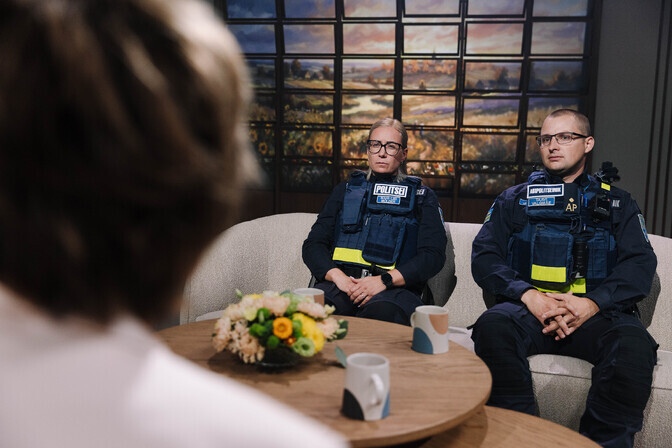
Mölder said importers and retailers of electric scooters have generally taken responsibility by not selling scooters capable of traveling faster than 25 kilometers per hour. However, scooters are also ordered from abroad where such controls may not be in place or where the speed restriction can be disabled at the push of a button. If parents have bought their child a scooter online, they can have a speed limiter installed by a retailer in Estonia.
Above all, however, Mölder recommends not buying electric scooters for children.
"This kind of vehicle shouldn't be in the hands of a child under 15 or 16 at all. Once a young person reaches 15 or 16, their behavior in traffic and their awareness of road safety have certainly developed. But younger children are very reckless and very unaware of the dangers," she said.
--
Editor: Marcus Turovski, Karmen Rebane
Source: "Hommik Anuga"


