A look back at Estonia's presidential elections | Episode 1: Lennart Meri, 1992
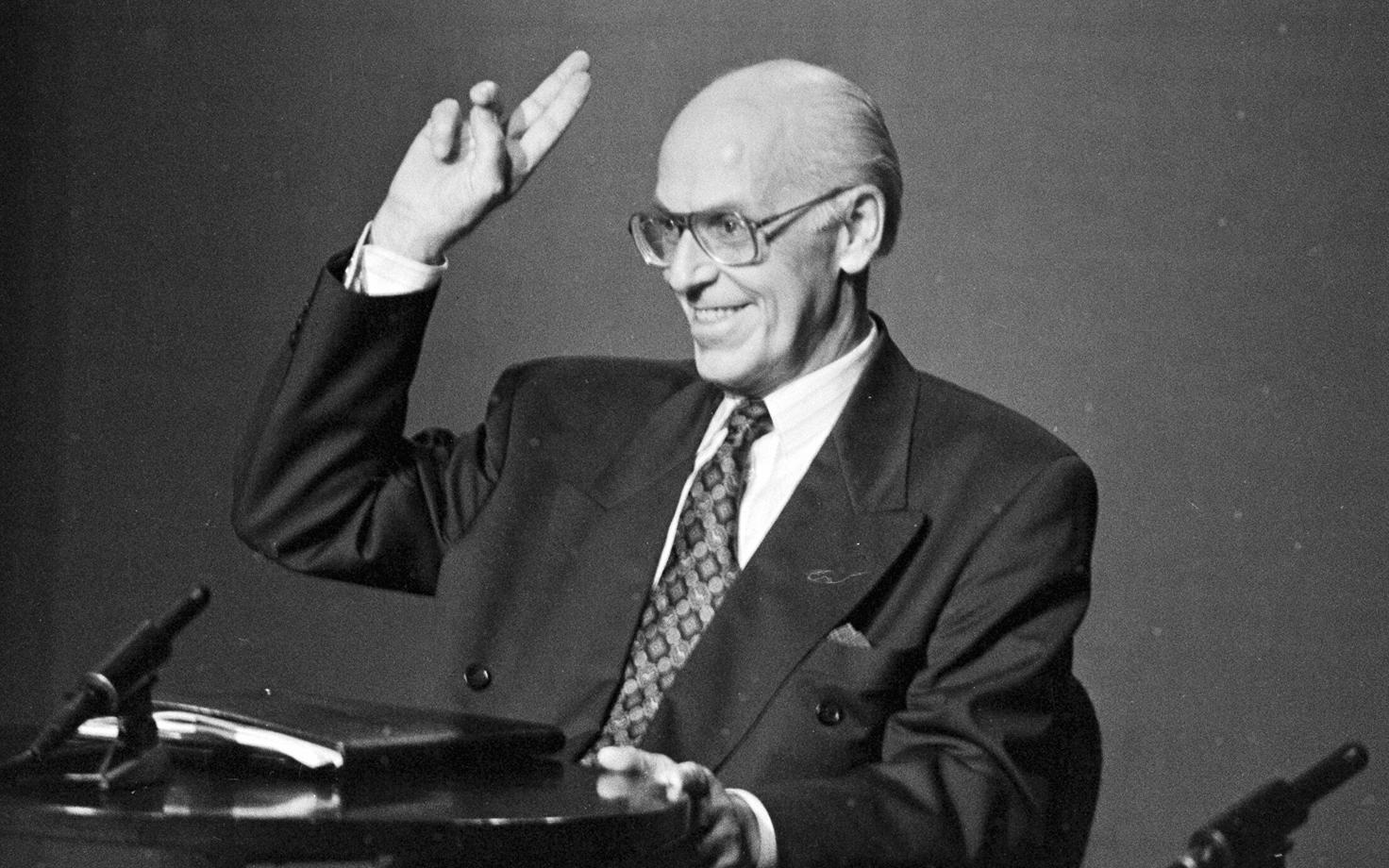
Thirty-four years ago, Estonia's first presidential election since restoring independence pitted four candidates against one another in a popular vote before the final decision passed to the newly elected Riigikogu and Lennart Meri emerged as president.
Estonia will hold its eighth presidential election this fall. Over the course of a week, ERR is looking back at the country's seven previous presidential elections, publishing one story each day featuring key figures from those elections. Tiit Pruuli, who was a member of Lennart Meri's campaign team, and Rein Taagepera, who ran for president, recall some of the key details of the 1992 presidential election.
Estonia's first presidential election after the restoration of independence, held in 1992, differed from all subsequent elections because it included a popular vote.
On August 20, Lennart Meri, who collected 11,491 signatures of support; Arnold Rüütel, with 21,009; Lagle Parek, with 10,839; and Rein Taagepera, with 14,887, were registered as presidential candidates.
On September 16, the four candidates took part in Estonia's first televised presidential candidates' debate on ETV.

Four days later, on September 20, the popular vote was held. Arnold Rüütel received the most votes, with 41.8 percent. Lennart Meri received 29.5 percent, narrowly beating Rein Taagepera, who received 23.4 percent.
However, because none of the presidential candidates received more than half the votes cast, no one was elected. Under the presidential election law, the decision then passed to the Riigikogu, with the names of the two most popular candidates, Arnold Rüütel and Lennart Meri, placed on the ballot.
As Isamaa had come to power in the Riigikogu elections held in September 1992 and Meri had been Isamaa's presidential candidate, it was no surprise that Meri received more votes than Rüütel in parliament. Meri received 59 votes and Rüütel 31, while 11 ballots were invalid. On October 5, 1992, Meri was elected the first president of Estonia since the restoration of independence.
Tiit Pruuli, who was a member of Meri's campaign team at the time, recalled that Rüütel's lead was secured by his down-to-earth, easily relatable image and his status as a symbol of the restoration of independence. Meri, meanwhile, was characterized at the time by a certain arrogance and deep intellectualism, which alienated some voters. To get closer to the public, Meri embarked on an extensive campaign, traveling around Estonia.
"Lennart stepped out of the intellectual's slippers — for the first time, though he would do so repeatedly later — and ran a very thorough campaign across Estonia. He traveled hundreds of thousands of kilometers around Estonia in the campaign car and met with people. So it was a tremendous amount of work," Pruuli said.
"The main strategy of Meri's campaign team from the very beginning was that we understood it would be impossible to beat Arnold Rüütel in the first (popular vote — ed.) round. The main strategy was therefore to make sure that Rüütel did not manage to win an absolute majority in the first round and that the matter would go on [to the Riigikogu]," Pruuli said.
Looking back at the contest between Rüütel and Meri, Pruuli also said he did not recall Rüütel presenting his views quite so explicitly during the campaign.
"His trump cards were his high name recognition and silver curls, and those certainly worked to his advantage. He didn't have to focus as much on setting out his views," Pruuli said.
In that respect, Pruuli said Rein Taagepera's decision to enter the race was very important. One of Taagepera's motivations was to support Meri and, in doing so, "eat into" Rüütel's share of the popular vote. Pruuli said, however, that Meri's team had no agreement with Taagepera.
"Taagepera was still an independent and autonomous candidate, so there were no agreements. Objectively speaking, Taagepera's entry into the race helped bring that about and we took into account that this could be the case, but there were no agreements."
Taagepera: I didn't like the prospect of the former chairman of the Supreme Soviet Presidium becoming president of a newly free Estonia
Rein Taagepera himself recalled that both the Popular Front, whose representatives even met him at the airport when he arrived in Estonia, and Lennart Meri wanted him to run. Taagepera himself hoped that his candidacy would help Meri's bid. He recalled that he initially said no to the Popular Front, but then received a phone call from Meri, who was in Helsinki and asked him to run.
"Why would anyone want a rival candidate? Lennart said he had health problems and that if something happened to him, there would be someone else. I knew very well what his 'health problem' was. It was the accusations from Lippmaa and Rüütel's circle asking why Stalin hadn't deported and killed his family. Why had he survived?"
"So, on the one hand, the Popular Front wanted to field its own candidate, while on the other, Meri's circle wanted to make sure Rüütel's supporters did not think that if they forced Meri out of the race with a smear campaign, the path would be clear for them. I agreed because I had been asked by both sides and I myself didn't like the prospect of the former chairman of the Supreme Soviet Presidium becoming president of an Estonia that was regaining its freedom," Taagepera said.

According to Taagepera, the fact that Meri finished behind Rüütel in the popular vote was a consequence of Taagepera's candidacy.
"When Lennart called me, I told him that if I entered the race, I would be running to win and would try to beat you, too. And he acknowledged that," Taagepera said.
According to Taagepera, Meri's team's calculation was that Taagepera would take more votes from Meri than from Rüütel, but would also take enough from Rüütel to prevent him from reaching 50 percent in the first round.
"Because Lennart and I were on the same wavelength and were competing for the same electorate," Taagepera said.
According to Taagepera, he finished behind Meri because the public wanted the president to come from Estonia and to be someone who had played an important role in restoring the country's independence. Taagepera said, however, that some calculations showed his popularity was on an upward trajectory and that if the campaign had lasted another week, he would have overtaken Meri.
Meri was elected president by parliament on October 5, receiving 59 votes to Rüütel's 31, with 11 invalid ballots. He was 63 when he became president.
Just one month later, in November 1992, Emor surveyed the public on how well Lennart Meri was performing his duties as president. Only 32 percent of respondents said Meri was doing a good job as president. Virtually the same proportion, 31 percent, thought he was doing a poor job. The remaining third had no opinion.
Such low support at the beginning of his presidency was understandable and could largely be explained by the fact that Rüütel had been the most popular candidate in the preceding popular vote. Meri's support, of course, did not remain that low. A year later, in December 1993, 58 percent already rated Meri's performance as president positively. The share with a negative view had remained essentially unchanged, at 34 percent.
The upward trend continued, and by March 1995, when Riigikogu elections were also held, 72 percent rated Meri's performance as president positively. Perhaps more importantly, the share of respondents who rated his performance negatively had fallen by half, to 18 percent.

--
Editor: Marcus Turovski