Ratings: Center Party support reaches seven-year high

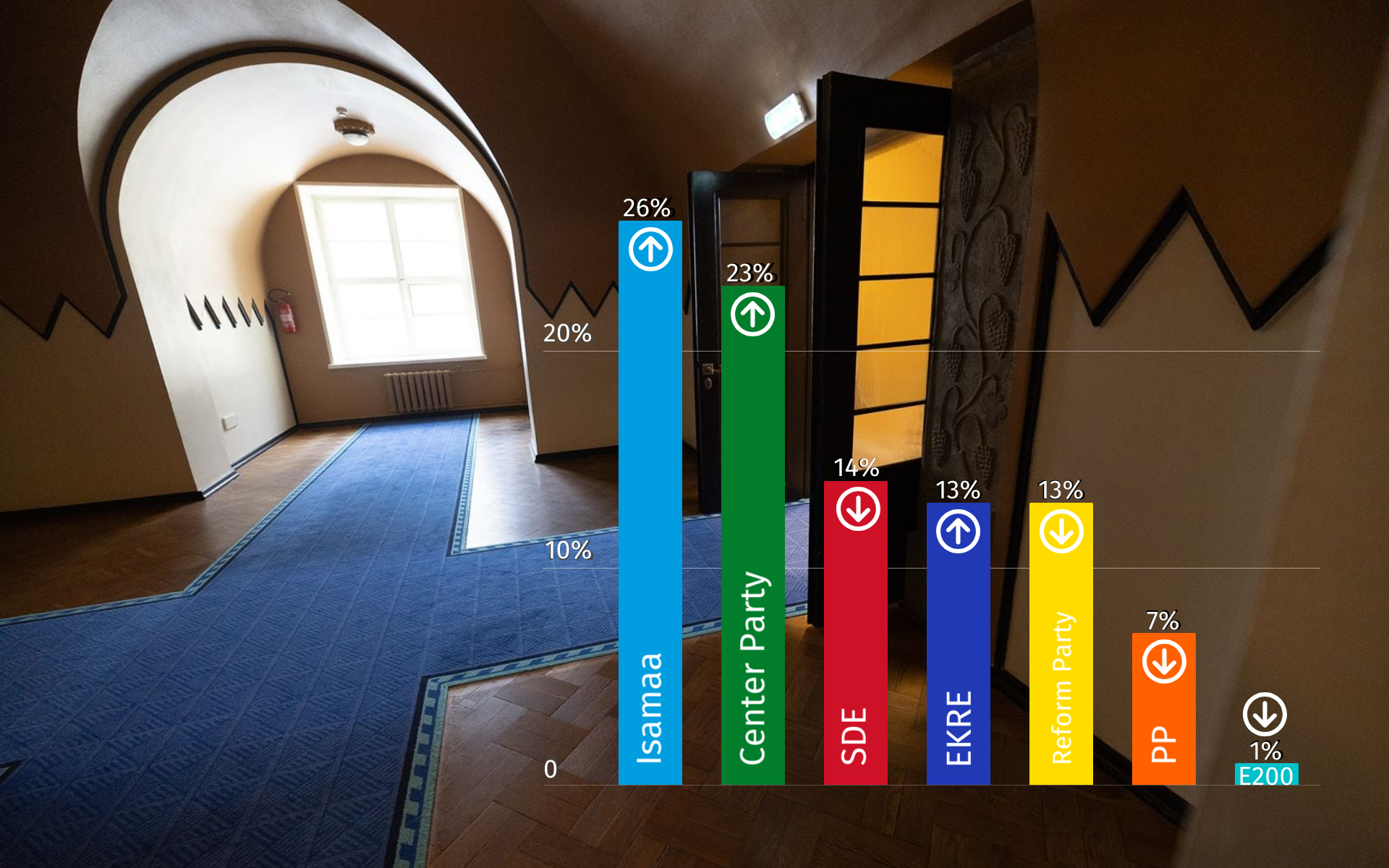
Opposition parties Isamaa and the Center Party saw the largest monthly gains in support in January, according to a recent poll.
The survey, conducted by Kantar Emor on behalf of ERR, found the Center Party had reached a seven-year high in support, driven mainly by the return to the fold of ethnic Estonian voters.
Support for Eesti 200 meanwhile fell to just 1 percent, according to the survey, the lowest rating the party, in office with Reform, has seen since it was founded in 2018.
Isamaa remained most supported party in January, with 26 percent, up from the 24 percent seen in the last month of 2025. Over the past year, Isamaa's support according to Kantar Emor's surveys has been in the 22-29 percent-range, and the party has topped the popularity charts since November 2023, or over two years.
The most noteworthy recent change has been the rise in support for the Center Party. The party's fortunes started to take a turn for the better from February last year, and now stands at 23 percent in the latest poll. This is the highest level of support the Center Party has recorded in Kantar Emor surveys in seven years since early 2019, since when there have been two Riigikogu elections (in March 2019 and March 2023). In early 2019, Center's leader was Jüri Ratas, now an Isamaa MEP but at the time prime minister of the Center-Isamaa-SDE coalition.
Center's upturn in support over the past month came primarily from a rising backing from ethnic Estonian-speaking respondents, which reached 12 percent in January – the highest level with that demographic since February 2022.
The low point for the Center's rating came in the first half of 2024, when for several months the party's support hovered around the 12–13 percent-mark, and as low as 4 percent from among native Estonian speaking respondents. Even the 43-percent rating from respondents of "other nationalities," in practice overwhelmingly meaning Russian-speaking voters, while still significant, was low compared with the party's historical rating with this demographic, traditionally a bedrock of support for Center, particularly in Tallinn and in northeast Estonia.
Center's rating with this social group started to rehabilitate a little ahead of the ethnic Estonian component's support, and now stands at 72 percent.
Among ethnic Estonian respondents, the fall in support for Center was also a little behind the overall curve, bottoming out at 2 percent in May 2024, rising to 4-5 percent thereafter but only starting to grow, even then gradually, from May last year. A greater surge in support came at the end of last year: As recently as November, support among ethnic Estonian respondents was still 7 percent, rising to 10 percent in December, and now 12 percent in January. Reasons for this can include disillusionment with the previous Reform-Isamaa-SDE-Eesti 200 administration in Tallinn, and the return to office in the capital for Center, after the October 2025 local elections.
At opposite ends of the political spectrum, the Social Democratic Party (SDE) and the Conservative People's Party of Estonia (EKRE) are next, closely followed by the coalition Reform Party. These three are all in the 13-14 percent support range.
Meanwhile the non-parliamentary Parempoolsed, founded in 2022 and winning its first seats at last fall's local elections, polled at 7 percent. This is above the 5-percent threshold required to win seats under Estonia's electoral system.
Support for Eesti 200 is at a record low of 1 percent, not only below the 5-percent threshold but also below the 2 percent of the vote required to qualify for state support, a major source of revenue for most parties.
Eesti 200's rating stood at 3 percent in December, and is now in January no higher than that of the Estonian Greens (Rohelised) and the pro-Kremlin Koos/Vmeste party.
Eesti 200's high-point so far as ratings go came in spring 2022, when it peaked at 21 percent. When it mattered, at the March 2023 Riigikogu elections, the party polled at 13.3 percent and won its first seats, 14 of them. It also entered office for the first time, together with the Reform Party and SDE, for Kaja Kallas' third administration. As is often the case, this was followed by a rise in the rating, to 17 percent in April 2023. However a donations scandal which engulfed one of the party's then-MPs was followed by plummeting support, to 13 percent in May, 9 percent in June 2023, and 4 percent in January 2024. Not only the scandal itself, which related to alleged embezzled funds from a charity aimed at supporting Ukraine, but also the party's perceived handling of it, and at least one other conflict of interest scandal, was behind the fall, a fall from which Eesti 200 has never recovered.
The party also lost one seat at that point and currently has 13 MPs.
The only party to poll below Eesti 200 in January 2026 is the ERK, which formed around a nucleus of dissident ex-EKRE members, in summer 2024.
In January, the combined support of the governing coalition parties (Reform and Eesti 200) stood at 14 percent, while the opposition's (SDE, EKRE, Center, Isamaa) stood at 76 percent.
Proportion of undecided respondents declined in January
According to Kantar, in January, 23 percent of respondents were unable to state a party preference, down from 25 percent in December, and even more so from the peak of 30 percent seen in recent months.
The above results include these undecided voters, but excluding them arguably gives a clearer picture of how a Riigikogu election might pan out if one were held today (since there is no "don't know" option on ballot sheets).
When respondents without a preference are included, Isamaa was still the leader at 20 percent in January, though with less than when undecided voters are included. Center picked up 17 percent via this methodology several percentage points below the overall figure, while SDE, Reform and EKRE were in a three-way tie again, this time at 10 percent; Parempoolsed polled a little lower at 5 percent, bang-on the threshold level, while Eesti 200, the Greens and Koos' results were unchanged at 1 percent each.
Isamaa even more well-backed by native Estonian speakers
Among ethnic Estonian respondents, Isamaa ranked first also, with an even higher rating of 30 percent. Center conversely polled lower than overall at 12 percent. Parempoolsed polled a little higher in this demographic alone with 8 percent, while Reform, SDE and EKRE again were in a three-way tie once again, but higher than with the overall results, at 15 percent each this time.X
Center's rating among native Estonians now outstrips Parempoolsed's, which it had not done before and is significantly close to Reform and EKRE, at polar opposites politically but generally mostly Estonian-backed parties.
As noted, Center polled at 72 percent among respondents from "other nationalities," but Isamaa polled far lower than nationwide, at 5 percent, the same rating as seen for SDE, and below Koos at 6 percent. Support for Parempoolsed among respondents of other nationalities was just 1 percent.
Isamaa has more men supporters than women, vice versa for Center
Isamaa's support base includes more men than women (31 and 21 percent respectively within the respondent groups) while more women (25 percent of respondents) than men (20 percent) picked Center.
EKRE and Parempoolsed also see more support from men, while SDE and the Reform Party have more women supporters than men, though with not such a large gap in the case of Reform and Parempoolsed, when compared with those parties more frequently picked by men.
By age group, SDE was most popular with 18-24-year-olds and joint favorite in the next age bracket (25-34). Center was most supported by the 35-49-year-old age group, while Isamaa topped the rankings in all the subsequent age brackets: 50-64, 65-74 and 75+.
By education, Center is now the most popular party among those with only a basic (junior high) education, while for high school graduates who did not go on to college, Isamaa is the most supported according to Kantar. For those who have a tertiary education, Isamaa and SDE are roughly evenly split.
Center biggest in Tallinn, Ida-Viru; Isamaa biggest elsewhere
Center remains most supported in Tallinn with a rating of 36 percent, followed by Isamaa with 18 percent. The two parties are in office together. SDE comes next at 16 percent, while Reform's rating in Tallinn is 11 percent. Reform was in office until last summer when it left the coalition. SDE remained in office until the local elections in October. EKRE polled at 7 percent in the capital, just ahead of Parempoolsed at 6 percent.
While Center retains its lead in its other traditional heartland, Ida-Viru County, Isamaa is most-supported in virtually all the other regions, by party (local government is dominated often by municipality-specific electoral alliances).
In the poll above, Kantar Emor surveyed 1,598 Riigikogu voting-age citizens (18+) across Estonia online and over the phone, January 14-21.
Kantar claims a maximum possible margin of error of +/-2.1 percentage points.
The next elections are to the Riigikogu in March 2027.
--
Editor: Urmet Kook, Andrew Whyte