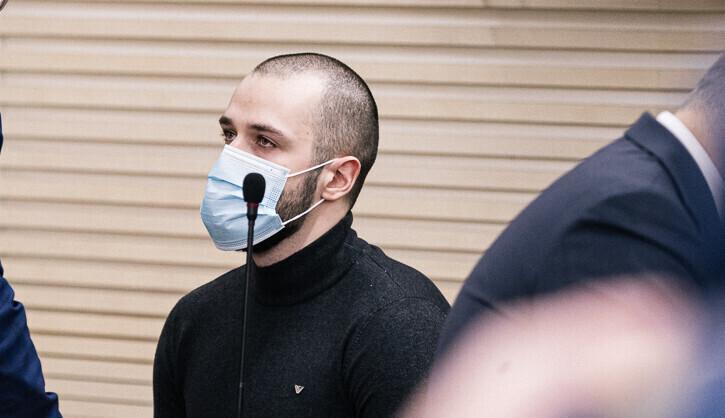
Estonian residence permit revoked for driver in Laagna tee fatal accident

The Police and Border Guard Board (PPA) has revoked the residence permit of a man who caused a 2020 road traffic accident in Tallinn, which killed two people.
The authority made the decision to revoke Isa Khalilov's residence permit last week, after the Supreme Court left in place a circuit court ruling which allowed him to walk free. Khalilov has been reported as a citizen of Azerbaijan and also of the Russian Federation.
Rainis Sinikas, head of the PPA's Northern Prefecture border and migration surveillance department, said the decision was based on an assessment of Khalilov's risk to Estonian residents.
"Foreign nationals must comply with migration rules and behave in a law-abiding manner in order to stay in Estonia. The PPA's task is to ensure the safety of Estonian residents and people staying here. When reviewing residence permits, we base our decision on whether or not a foreigner may pose a threat to public order."
Despite the residence permit revocation, Khalilov will not be deported immediately, due to his ongoing probation period. A decision on whether he can remain in Estonia until the end of his probation is due to be made by the Ministry of Justice's probation department. A court bailiff will be responsible for enforcing any fines.
Khalilov caused the deadly accident on Tallinn's Laagna tee in June 2020, when he was involved during a BMW X5 model, in a high-speed race with another car. The accident he caused, near the Mustakivi bridge, resulted in two fatalities and multiple injuries to four more people. One of the injured subsequently died, as a result of their injuries, a year after the accident.
He was sentenced to eight years in prison but has been released on probation, earlier than expected and despite objections from the prosecutor's office.
Khalilov has been placed on probation until June 2030, with strict conditions which include regular meetings with a probation officer, a ban on alcohol consumption and drug use, continued secondary education, attending road traffic safety programs, and wearing a monitoring device for one year.
The Prosecutor's Office opposed his early release, citing concerns about his weak connection to Estonia, his failure to pass the B2 language exam, and his difficulty in finding work, compounded by the sentence and language issues.
The second-tier circuit court, however, justified his release after taking into consideration his age – Khalilov was 20 at the time of the accident – reoffending risks, and the fact he has expressed remorse over the crime. He also reportedly completed 10th and 11th high school grades while
--
Editor: Andrew Whyte